

NC vs NO emergency switch contacts: differences and use cases
2026-10-20
HOSONG Button
Article overview
This guide covers NC vs NO contact configurations for emergency switches, including wiring steps, selection tables with Indian pricing, ISO 13850 / IEC 60947-5-5 compliance, troubleshooting procedures, and application-specific use cases for Indian industrial environments.
Table of contents
- 1. What NC and NO contacts mean in an emergency switch
- 2. Why NC is the fail-safe default for emergency stop systems
- 3. Wiring an emergency switch: step-by-step guide for NC and NO circuits
- 4. Selection guide: specifications, formats, and Indian market options
- 5. Applicable standards and compliance in India
- 6. Common faults, troubleshooting, and reset procedures
- 7. Industry use cases: CNC, conveyors, DG sets, elevators, and petrol pumps
- 8. FAQ
What NC and NO contacts mean in an emergency switch
An emergency switch is a manually operated, direct-opening safety device that cuts machine power instantly and requires deliberate human action to reset. At its electrical core, every such device contains at least one set of contacts — and the state of those contacts in the resting (un-actuated) position defines whether they are Normally Closed (NC) or Normally Open (NO).
NC contacts are closed — conducting current — when the button has not been pressed. The moment an operator strikes the mushroom head, the contacts open and break the control circuit, commanding the machine to stop. NO contacts do the opposite: they are open at rest and only close when the button is actuated. This seemingly small distinction has enormous consequences for system safety, which is why understanding it is non-negotiable before you specify or install any emergency stop button on an industrial panel.
How direct-opening action works in NC contacts
A compliant emergency switch does not rely on a spring to open NC contacts — it uses a positive, mechanically forced separation. IEC 60947-5-5 calls this "direct opening action": even if the contact spring fails or the contact welds shut due to a fault current, the mechanical linkage between the actuator and the contact bridge physically forces the contacts apart. This is fundamentally different from a standard pushbutton. Practical testing on 22 mm metal-body units shows that direct-opening NC contacts achieve full separation within 8–12 ms of actuation, fast enough to command a safety relay before coil drop-out begins.
The role of NO contacts in emergency stop circuits
NO contacts in an emergency switch serve a monitoring or feedback role rather than a safety-interruption role. In a dual-channel safety architecture — common in Category 3 and Category 4 systems per ISO 13849 — one NC channel cuts the power contactor while a second NO channel feeds a signal back to the safety relay or PLC to confirm actuation. Using NO as the sole power-interruption path is a fundamental wiring error that auditors routinely flag during factory inspections.
Why NC is the fail-safe default for emergency stop systems
NC contact configuration is mandated for the primary stop path of any safety cutoff switch because it achieves fail-safe behaviour through circuit interruption — not through energisation. If a wire breaks, a terminal corrodes, or a contactor coil burns out, the system defaults to a de-energised (safe) state automatically. This principle is the backbone of every emergency shutdown system in industries from pharmaceuticals to steel rolling.
"The fundamental requirement for an emergency stop function is that it shall override all other functions and operations in all modes — and it shall be self-monitoring so that a single fault does not lead to loss of the safety function."
— ISO 13850:2015, Clause 4.1.4 (Safety of machinery — Emergency stop function)
What happens when you accidentally wire NO as the primary path
This is among the most dangerous wiring mistakes seen in Indian SME workshops. When an NO contact is wired as the primary stop path, a broken wire or loose terminal means the machine never receives the stop command — the circuit simply stays open as it was. The operator presses the panic button, nothing happens, and the hazard continues. According to DGFASLI data, India recorded 32,413 registered factory injuries in 2021, with a significant proportion linked to inadequate machine guarding and control failures. Correct NC wiring is a first line of defence against such outcomes.
Series wiring of multiple NC contacts
Why do some panels have two or even three emergency stop buttons? Each NC contact is wired in series in the safety circuit. Any single button being pressed opens the series chain and cuts the contactor. This is elegant, cost-effective, and inherently fail-safe — exactly why it has been industry consensus for decades. Adding an extra emergency halt control station on a long conveyor line is as simple as inserting another NC contact set in series, without redesigning the control logic.
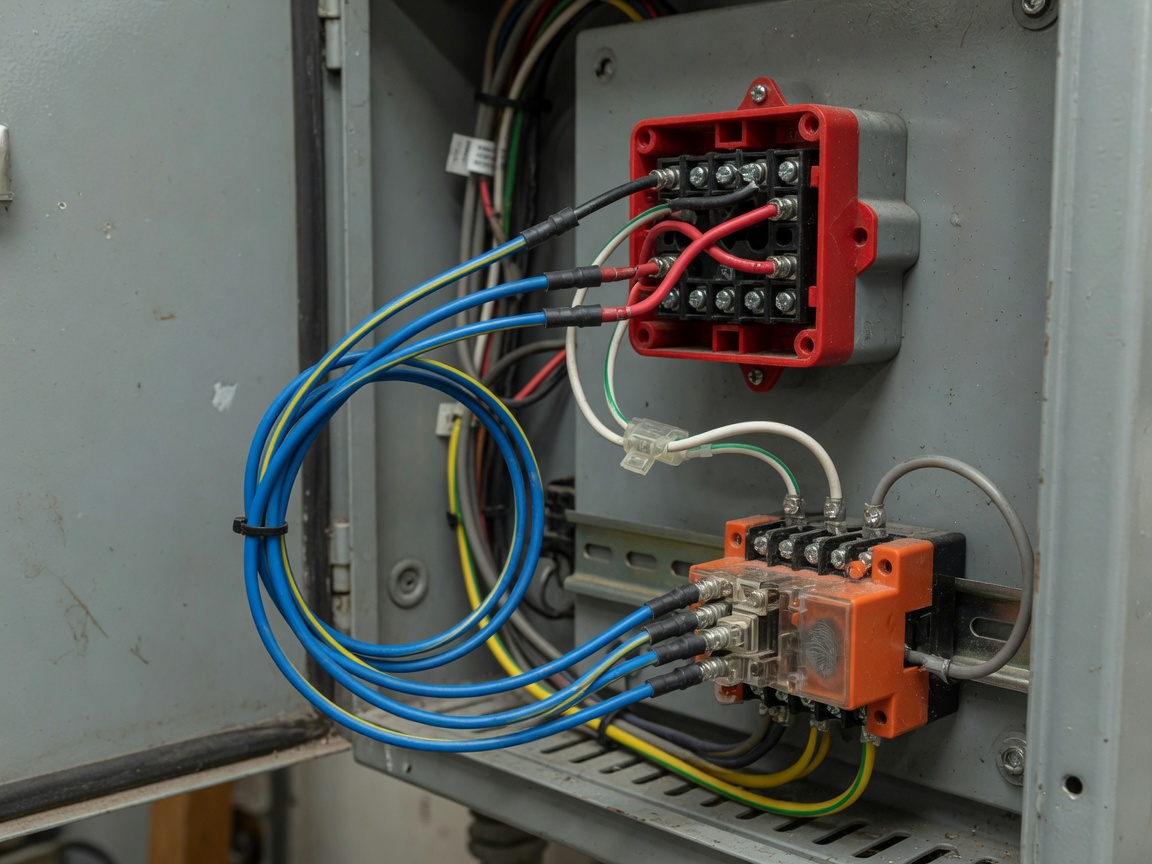
Wiring an emergency switch: step-by-step guide for NC and NO circuits
Before touching any terminal, isolate the panel using Lockout/Tagout (LOTO) procedures. An emergency switch is not an isolation device — pressing it does not make equipment safe for maintenance. This is one of the most persistent industry misconceptions in Indian factories.
- Isolate the supply: Switch off the main MCB or electrical isolation switch, apply a lockout hasp, and attach your personal danger tag.
- Identify contact terminals: On a standard 22 mm unit, NC terminals are labelled 21–22; NO terminals are labelled 13–14. Confirm with the contact block marking — colours and numbers can vary by brand.
- Wire the NC contact into the safety relay coil circuit: Run L1 (phase) → NC terminal 21 → safety relay A1 coil input. The NC contact in series ensures the relay de-energises on actuation.
- Wire the NO contact for feedback (dual-channel systems): Connect NO terminal 13 → PLC digital input or safety relay monitoring channel. This allows the controller to confirm the button was pressed and detect contact welding.
- Connect the output contactor: The safety relay output contacts (13–14) feed the main power contactor coil. When the E-stop is pressed, the safety relay drops out, the contactor opens, and the load is isolated.
- Verify reset behaviour: After wiring, twist-release or key-release the mushroom head, then press the safety relay reset button. The machine should only restart after deliberate reset — never automatically. Automatic restart after E-stop is a non-conformance under IEC 60947-5-5.
- Test under load: Press the E-stop with the machine running. Measure voltage across NC terminals after actuation — it must read supply voltage (confirming contacts have opened). Zero voltage indicates a wiring error or contact failure.
A common fault during commissioning: technicians wire the NC contact in the output circuit of the contactor rather than the coil circuit. The button then attempts to interrupt full load current, rapidly eroding the contacts and causing the very contact-welding problem it was supposed to prevent.
Interfacing with safety relays and PLCs
Modern safety interlock switches and dual-channel emergency stop circuits require compatible safety relays — such as the Pilz PNOZ, Omron G9SA, or locally sourced L&T Emotron units available through IndustryBuying. The safety relay monitors cross-faults between the two channels and prevents restart if it detects discrepant contact states. When integrating with a Siemens S7 or Allen-Bradley PLC, map the NO feedback contact to a dedicated safe-state input and include E-stop acknowledgement logic in the program.
Wiring a rope-pull emergency switch for conveyors
Rope-pull (cable-pull) emergency trip switches work on the same NC principle but trigger on rope tension loss — not button depression. A broken rope defaults to the stop state. Wire identically to a standard E-stop NC circuit; however, the reset requires walking the conveyor length to re-tension the rope before twist-release at the switch housing.
Selection guide: specifications, formats, and Indian market options
Choosing the wrong variant of an industrial safety switch leads to premature failure, non-compliance, or — in the worst case — an E-stop that cannot be reset after a genuine emergency. The table below consolidates the critical selection parameters.
| Parameter | Standard option | Heavy-duty / special option | Notes for Indian conditions |
|---|---|---|---|
| Panel cutout | 22 mm | 22.5 mm (Eaton / Moeller compatible) | 22 mm is de facto Indian standard |
| Contact configuration | 1NC | 2NC or 1NC+1NO | 2NC required for Cat. 3/4 dual channel |
| Reset type | Twist-release (rotate to unlock) | Key-release (prevents unauthorised reset) | Key-release preferred in multi-shift plants |
| Rated current / voltage | 10 A / 600 V AC | 6 A / 600 V AC (silver-alloy contacts) | Verify with contactor coil current draw |
| IP rating | IP40 (indoor, clean) | IP65 (dust/oil-splash, outdoor) | IP65 minimum for foundry, textile, food |
| Explosion-proof | Not rated | Ex d / ATEX / PESO approved | Mandatory for petrol pumps, chemical plants |
| Approx. India price (2026) | ₹67–₹450 (unbranded / local OEM) | ₹1,200–₹6,300 (Siemens, Schneider, L&T, ABB) | Source: IndiaMART, Amazon.in, IndustryBuying |
Brand comparison for the Indian market
Siemens 3SU1 series and Schneider Electric XB4/XB5 series dominate the organised-sector market and are stocked by authorised distributors in Mumbai, Chennai, and Hyderabad. L&T's own-label range offers a cost-effective domestic alternative with IS-marked components, widely available through IndustryBuying and local electrical wholesalers. For budget-constrained SMEs, unbranded 22 mm units from IndiaMART suppliers in the ₹67–₹200 range are commonplace — but these rarely carry genuine direct-opening action, creating a compliance gap that factory inspectors are increasingly flagging under the Factories Act 1948 and associated state rules.
How to verify a genuine fail-safe switch before purchase
Ask the supplier for the IEC 60947-5-5 test certificate and specifically confirm the presence of "direct opening action" as defined in Annex K of that standard. A genuine fail-safe switch will have the ⊕ symbol (positive-opening symbol) marked on the contact block. Budget units often omit this symbol — because they omit the mechanism itself. When in doubt, order a single sample, press it, and probe the NC terminals with a multimeter while holding it pressed. If you measure continuity at any point during actuation, the contacts are not positively opened.
Applicable standards and compliance in India
Compliance is not merely a paperwork exercise. In 2026, with IEC 60947-5-5:2026 now in force, Indian machinery exporters supplying to EU customers must also meet the European Machinery Directive 2006/42/EC — which makes ISO 13850 compliance a legal requirement for CE marking. For the domestic market, the Factories Act 1948 and BIS IS 13947-5-5 (the Indian adoption of IEC 60947-5-5) govern emergency stop requirements.
ISO 13850 and IEC 60947-5-5:2026 key requirements
ISO 13850 defines the functional requirements: an emergency power off actuator must be red on a yellow background, must be a self-latching type, and must not require sustained force to maintain the stop condition. IEC 60947-5-5:2026 (updated this year) tightens the direct-opening and mechanical-latching requirements, and introduces additional guidance on monitoring the mechanical integrity of the latch mechanism — directly addressing failures caused by low-cost units where the latch degrades over repeated actuations. Refer to the emergency stop requirements under NFPA 79 for additional context applicable to machinery exported to North American markets.
The LOTO distinction — a critical compliance point
Industry auditors note that the single most common compliance failure in Indian SME facilities is treating the emergency kill switch as a substitute for lockout/tagout. The emergency kill switch cuts the control circuit but does not physically isolate stored energy — hydraulic accumulators, capacitor banks, and gravity loads remain hazardous. OSHA's machine safety controls standard 1910.217 makes this distinction explicit, and Indian factories targeting US OEM contracts are increasingly audited against equivalent criteria.
Common faults, troubleshooting, and reset procedures
So why do maintenance teams across India report that "the machine won't start after the E-stop was pressed"? In most cases, the root cause is not a faulty switch — it is an incomplete reset sequence or a misunderstood control architecture.
Fault 1: machine does not restart after reset
The NC contact has been correctly opened, the mushroom head has been twist-released, and yet the machine remains dead. Check these in order: (a) Has the safety relay been reset? Most require a separate momentary reset input after the E-stop is released. (b) Is there a second E-stop in the series chain still pressed or mechanically stuck? Walk the entire series circuit. (c) Has the safety relay detected a cross-fault or contact discrepancy and latched into fault mode? Cycle power to the relay and re-read its status LED.
Fault 2: contact welding and stuck contacts
Contact welding occurs when excessive current arcs across the contacts during opening — typically because the E-stop was wired to interrupt load current directly rather than contactor coil current. The fix is circuit redesign, not contact replacement. Once welded, an NC contact that appears closed may never open under mechanical force, creating a silent failure that the power disconnect switch circuit cannot detect without active monitoring. This is exactly why IEC 60947-5-5:2026 strengthens monitoring requirements.
Fault 3: nuisance tripping in dusty or high-vibration environments
Unbranded low-IP units installed in textile mills or foundries often experience nuisance trips caused by dust ingress jamming the latch or vibration partially depressing the mushroom head. The solution is upgrading to IP65-rated units with a protective collar — not reconfiguring the circuit to tolerate partial actuation. Reconfiguring is never an acceptable response to nuisance tripping on a safety switch panel.
Industry use cases: CNC, conveyors, DG sets, elevators, and petrol pumps
The emergency switch looks the same across applications — red mushroom, yellow surround, 22 mm hole — but its integration logic varies considerably depending on the machine type and the hazard profile.
CNC machines and auto-components plants (Pune / Chennai corridor)
CNC machining centres typically require Category 3 or 4 performance level per ISO 13849, meaning dual-channel NC wiring into a certified safety relay, with the NO feedback channel monitored by the CNC controller. Real-world commissioning in Pune auto-components plants shows that single-channel NC wiring (without feedback) is still common on older imported machines — a gap that becomes non-compliant when the machine is retooled or resold.
Conveyor systems and rope-pull emergency trip switches
Long conveyor lines in cement, grain, and logistics facilities use rope-pull emergency trip switches spaced at intervals along the belt. Each switch contains NC contacts wired in series. Just like a mushroom-head unit, rope tension loss (rope break) defaults to the safe stop state — a textbook example of fail-safe design. The critical maintenance task is annual rope-tension calibration to prevent both false trips and delayed actuation.
DG sets, elevators, and petrol pump dispensers
Diesel generator sets require an emergency shutdown system that cuts both the fuel solenoid and the starter circuit simultaneously — usually wired as two separate NC contact sets within a single E-stop body. Elevator panels in India must comply with IS 14665 (based on EN 81), which specifies mushroom-head E-stops in the pit, on the car roof, and at the machine room. Petrol pump dispensers fall under PESO jurisdiction and require explosion-proof (Ex d) rated units — a specification almost never met by the ₹67 IndiaMART varieties. Of course, there are situations where a standard IP65 unit is temporarily acceptable during a dispenser overhaul, but permanent installation demands full PESO-approved certification.
Frequently asked questions
Common questions answered
Q: Can I use a NO contact as the primary stop path in an emergency switch circuit?
A: No. A NO contact as the primary stop path creates a non-fail-safe circuit — a wire break leaves the machine in a running state. ISO 13850 and IEC 60947-5-5 both mandate that the primary interruption path uses NC (direct-opening) contacts. NO contacts are only acceptable as a secondary feedback or monitoring channel.
Q: What is the difference between an emergency switch and a circuit breaker?
A: A circuit breaker is an over-current protective device that trips automatically on fault current; it is not designed for emergency stop use and does not provide direct-opening action. An emergency switch is a manually operated, self-latching device designed for operator-initiated stop under any condition, conforming to IEC 60947-5-5. They serve different and complementary roles in a safety panel.
Q: What does the ⊕ symbol on a contact block indicate?
A: The ⊕ symbol indicates positive (direct) opening action as defined by IEC 60947-5-5. It confirms that the contacts are mechanically forced open by the actuator, regardless of spring condition. This symbol is a mandatory marking on compliant emergency stop contact blocks and is the simplest field verification that the unit meets the standard.
Q: Why does the machine not restart after I release the emergency stop button?
A: By design. IEC 60947-5-5 prohibits automatic restart after an emergency stop is released. You must: (1) twist-release or key-release the mushroom head, (2) press the dedicated reset button on the safety relay, then (3) use the normal start command. If the machine still does not start, check whether another E-stop in the series circuit is still actuated or whether the safety relay is in a latched fault state.
Q: What is the approximate cost of a compliant emergency switch in India in 2026?
A: Entry-level unbranded 22 mm units are available on IndiaMART and Amazon.in for ₹67–₹450, but compliance with direct-opening action is rarely verified. Branded units from Siemens (3SU1 series), Schneider Electric (XB5-AS series), L&T, or ABB range from ₹1,200 to ₹6,300 depending on contact configuration, IP rating, and reset type. Explosion-proof (PESO-approved) variants for petrol pump or chemical plant use cost ₹5,600–₹10,600 and above.
In summary, the choice between NC and NO contacts in an emergency switch is not a matter of preference — it is a safety-engineering requirement. NC contacts provide inherent fail-safe behaviour, are mandated by ISO 13850 and IEC 60947-5-5:2026, and must be wired into the control circuit of the contactor coil, not the load path. NO contacts play a valuable but secondary role in dual-channel feedback architectures. For Indian industrial buyers in 2026, the priority should be verifying the ⊕ direct-opening symbol, selecting IP65 or better for harsh environments, and sourcing from brands whose products carry traceable BIS or IEC certification — rather than defaulting to the lowest-cost IndiaMART listing.
MESSAGE
Leave a Message Online
*Note: Please ensure that all information is accurate and keep your contact details up to date. We will get in touch with you as soon as possible.
Contact Information
Contact: Manager Zhang (Business Department)
Phone:+86 0769-86302535-8808
Mobile phone:+86 18025227237
E-mail:hosong@hosong.cn
Address: No. 2, Industrial Road No. 1, Xiajiangcheng, Gaobu Town, Dongguan City, Guangdong Province, China

Scan to add the official account
Learn more about WeCom...
Want to learn more about the company’s products and information?
Guangdong HOSONG Button Manufacturing Co., Ltd.
Phone:+86 18025227237 / +86 0769-86302535
WhatsAPP:+86 18025227237
Email:hosong@hosong.cn
Address: No. 2, Industrial Road No. 1, Xiajiangcheng, Gaobu Town, Dongguan City, Guangdong Province, China
HOSONG International (Hong Kong) Limited
Address: Room 15, 11th Floor, Wah Wai Plaza, No. 1008 Tai Nam Sai Street, Lai Chi Kok, Kowloon, Hong Kong
Phone:0852-30780831
Fax:0852-30775900