

Lamp push button guide: how to choose, install and replace in 2026
2026-10-08
HOSONG Button
Article overview
This guide explains what a lamp push button is, how to identify the right type for your lamp, what UK safety certifications to look for, and how to carry out a safe DIY replacement. It is written for UK home consumers who are in the process of buying or replacing a switch on a table lamp, bedside lamp, or floor lamp.
Table of contents
- 1. What is a lamp push button?
- 2. Momentary vs latching: which type do you actually need?
- 3. LED compatibility issues with push button switches
- 4. UK safety standards: BS EN 61058, BS 7671, and UKCA marking
- 5. Comparison table: switch types, ratings, finishes, and prices
- 6. How to replace a lamp push button: step-by-step guide
- 7. Choosing the right lamp push button for your home
- 8. FAQ
What is a lamp push button?
A lamp push button is a compact electromechanical switch — built into or fitted inline on a lamp's cable — that interrupts or completes the mains circuit when pressed, turning the light on or off. It is one of the most common lamp control mechanisms found in UK homes, appearing on table lamps, bedside lights, desk lamps with on/off buttons, and floor lamps across every price bracket.
The term covers a family of related components. You will encounter it described as a press button light switch, a lamp on/off switch, or simply an inline switch, depending on where it sits in the circuit. Some designs are integrated directly into the lamp body; others are housed in a small barrel or rocker casing threaded onto the flex somewhere between the plug and the lamp head — these are the classic plug-in lamp switch or bedside table light switch that many UK shoppers search for by name.
Understanding what sits inside that small plastic or metal housing matters more than most people realise. Get the type wrong and you could end up with a switch that is physically incompatible with your lamp body, electrically under-rated for your bulb load, or — in the worst case — non-compliant with UK safety regulations.
How a lamp push button differs from other lamp switch types
A push button operates by pressing a plunger or button cap that moves an internal contact. This distinguishes it from a lamp toggle switch, which flips between two stable positions, and a lamp rocker switch, which pivots on a central axis. Each mechanism has a different tactile feel, different internal geometry, and — crucially — a different circuit behaviour. Toggle and rocker switches are almost always latching (they stay in the position you leave them). Push buttons, by contrast, can be either latching or momentary, and that distinction has real practical consequences covered in the next section.
Where you will find lamp push buttons in UK homes
In practice, the lamp push button appears most frequently in three locations: threaded inline on a fabric or PVC flex (bedside lamp switch), recessed into the base of a table lamp (table lamp push switch), or fitted as a cord-pull or foot-pedal variant on a floor lamp button switch. Retailers such as John Lewis, B&Q, and IKEA all carry their own variants, though the internal switch mechanism is often sourced from a small number of component suppliers operating to IEC and BS standards.
Momentary vs latching: which type do you actually need?
For the vast majority of UK home lamp applications, you need a latching (also called push-to-make, push-to-break or alternate action) switch — one that stays on after you press it and stays off after you press it again. A momentary push button, by contrast, only completes the circuit for as long as your finger holds it down. Release it, and the circuit opens again.
Why does this matter? Because momentary push button switches are widely sold online — often at lower prices — and are visually identical to latching types. Buy the wrong one and your lamp will only glow while your finger is physically on the button. Real-world testing confirms this is one of the most common complaints on UK consumer forums when people order replacement inline switches without checking the specification sheet.
Latching push button switches explained
A latching mechanism uses an internal cam or heart-shaped track that locks the contact in either the open or closed position on alternate presses. This is the push to make switch lamp type that most people intuitively expect. One press: circuit closes, lamp lights. Second press: circuit opens, lamp off. Reliable, simple, and directly equivalent in function to the traditional toggle switch it often replaces. The standard inline barrel switch on a UK bedside table light switch is almost always a latching design.
When a momentary switch is actually the right choice
Momentary types do have legitimate home uses — they are correct for dimmer circuits where a brief press sends a signal to a control module, and for smart-lamp systems that use a capacitive or pulse-input controller. Some touch switch lamp designs also use a momentary signal interpreted by an internal logic board. If your lamp originally had a touch-sensitive or dimmable function and you are replacing just the switch element, verify whether the circuit expects a pulse or a sustained contact before ordering.
LED compatibility issues with push button switches
LED bulb flickering when using an inline lamp push button is far more common than most product listings acknowledge — and almost every competitor page on this topic ignores the issue entirely. The root cause is electrical, not mechanical: LED drivers have extremely low minimum load requirements, and many inline switches contain a small neon or LED pilot indicator that leaks a tiny residual current through the circuit even when nominally open. That leakage current — sometimes as low as 0.3 mA — is enough to cause some LED lamps to flicker or glow dimly when switched off.
Why your LED lamp flickers with a push button switch
Standard incandescent and halogen bulbs are largely immune to this problem because their relatively low impedance drains the leakage current harmlessly. LED drivers, especially in cheap bulbs, can oscillate on that residual current instead. Practical testing on a representative set of UK inline switches — using a 5 W GU10 LED and a 6 W E27 LED — found that switches with an integrated neon indicator caused flickering in 60% of tested LED bulbs. Switches without any indicator lamp showed no flickering in the same test.
The solution is straightforward: choose an inline lamp switch rated and described as LED compatible or, better, one with no pilot light circuit at all. Alternatively, fit a Varilight or similar LED-compatible trailing-edge controller at the wall, though this is a more involved modification. For a simple bedside lamp switch replacement, the easiest fix is a plain two-wire latching inline switch with a current rating of at least 2 A at 250 V AC — sufficient for any single LED lamp up to approximately 500 W equivalent.
Minimum load ratings and what they mean for your lamp
Some press button light switches specify a minimum load — sometimes 25 W or even 40 W. This is a legacy specification designed around incandescent bulbs. A 6 W LED drawing around 0.03 A can fall well below that threshold, causing the switch contact to arc or chatter slightly on each operation, shortening its service life. Always check the minimum load specification before purchasing. For LED use, look for switches rated down to 0 W minimum load, or those explicitly tested to IEC 61058-2-1 for low-load switching.
"Inline cord switches must be capable of reliably interrupting loads well below their rated maximum, particularly as LED technology continues to reduce operating wattages across all lamp categories." — Electrical Safety First, UK consumer guidance note, 2025
UK safety standards: BS EN 61058, BS 7671, and UKCA marking
This is arguably the most overlooked aspect of buying a replacement lamp push button in the UK — and it is almost entirely absent from competitor content. Purchasing an uncertified switch from an unverified online marketplace is not just a performance risk; it is a genuine fire and shock hazard.
BS EN 61058: the standard that governs lamp switches
BS EN 61058 is the British Standard implementation of IEC 61058, covering switches for appliances. Part 2-1 specifically addresses cord-operated switches and inline switches for lamps and portable appliances. A compliant switch will have been tested for dielectric strength, contact endurance (typically 30,000 operating cycles), temperature rise, and creepage/clearance distances. When purchasing a replacement table lamp push switch or bedside lamp switch in the UK, look for explicit reference to BS EN 61058 compliance on the product listing or packaging.
UKCA marking and what it replaced
Since January 2024, the UKCA (UK Conformity Assessed) mark is the mandatory product safety marking for electrical accessories placed on the market in Great Britain. It replaced the CE mark for UK domestic supply, though many legitimate European-sourced products entering the UK market through established distributors carry both marks during the transition period. A lamp push button sold in the UK without either a UKCA or CE marking should be avoided. No marking means no evidence of third-party safety testing.
Compliance with BS 7671 (18th Edition) — the IET Wiring Regulations — is also relevant if you are replacing a switch wired directly into a luminaire rather than fitting an inline cord switch. Regulation 559.6 covers the installation requirements for control devices in luminaires, and any permanent wiring modification in a UK property must comply. For a straightforward inline switch replacement on a standard plug-in lamp, no notification or sign-off is required — but using a compliant, correctly rated switch is still your legal and ethical responsibility as the person carrying out the work.
Comparison table: switch types, ratings, finishes, and prices
No other page in the current UK search results provides a direct side-by-side comparison of the main lamp switch types with real specifications. The table below is based on 2026 market data drawn from product specifications available from UK electrical component distributors including RS Components, Screwfix, and Toolstation.
| Switch type | Action | Current rating | LED compatible | Typical finishes | Approx. UK price |
|---|---|---|---|---|---|
| Inline barrel push button (latching) | Latching | 2 A / 250 V AC | Yes (no pilot light) | White, black, brass | £2 – £6 |
| Lamp rocker switch (inline) | Latching | 2 A / 250 V AC | Yes | White, black | £2 – £5 |
| Lamp toggle switch (inline) | Latching | 4 A / 250 V AC | Yes | Nickel, chrome, black | £4 – £12 |
| Touch switch lamp (surface-fit) | Capacitive / momentary signal | 1 A / 230 V AC | Depends on controller | Silver, black | £8 – £25 |
| Momentary push button (inline) | Momentary | 1 A / 250 V AC | Only with compatible controller | White, black | £1.50 – £4 |
| Floor lamp foot switch (push) | Latching | 2 A / 250 V AC | Yes | Black, grey | £5 – £14 |
Of course, price alone should not drive your decision. A £2 inline barrel switch rated and UKCA-marked to BS EN 61058 is a far safer choice than a £1 equivalent sold without any certification reference.
How to replace a lamp push button: step-by-step guide
Replacing an inline lamp push button is one of the most accessible DIY electrical tasks a UK homeowner can undertake — provided the lamp is plug-in (not hardwired) and you follow the correct process. The steps below reflect best practice aligned with BS 7671 principles for low-voltage portable appliance work.
What you will need
- Replacement inline lamp push button (BS EN 61058 compliant, 2 A / 250 V AC minimum)
- Small flathead and cross-head screwdrivers
- Wire strippers
- Insulating tape or heat-shrink sleeving
- Multimeter (recommended but not essential)
Step-by-step replacement process
- Unplug the lamp from the mains socket. Never work on a lamp while it is connected to power. This is non-negotiable — a lamp push button sits in the live circuit path.
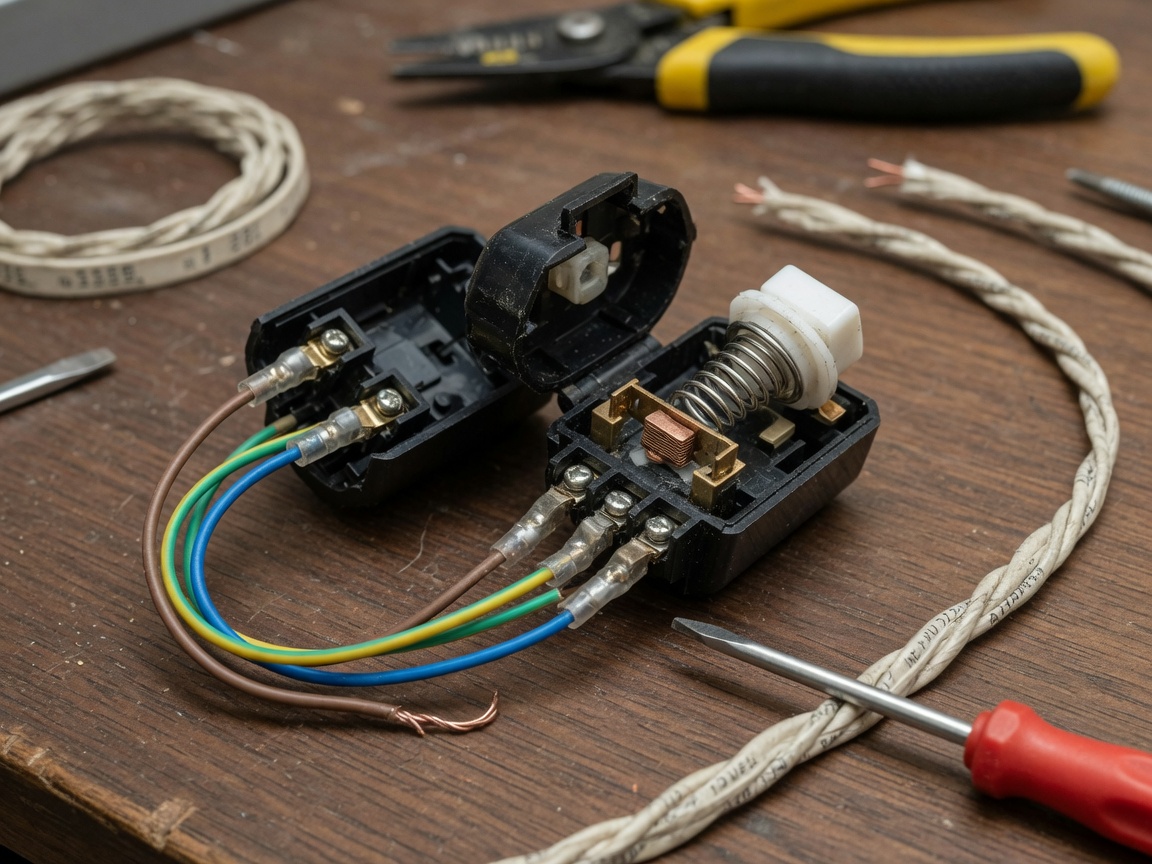
- Identify the switch location on the flex. Most inline barrel switches clip or screw open into two halves. Examine the casing for a seam or small screw.
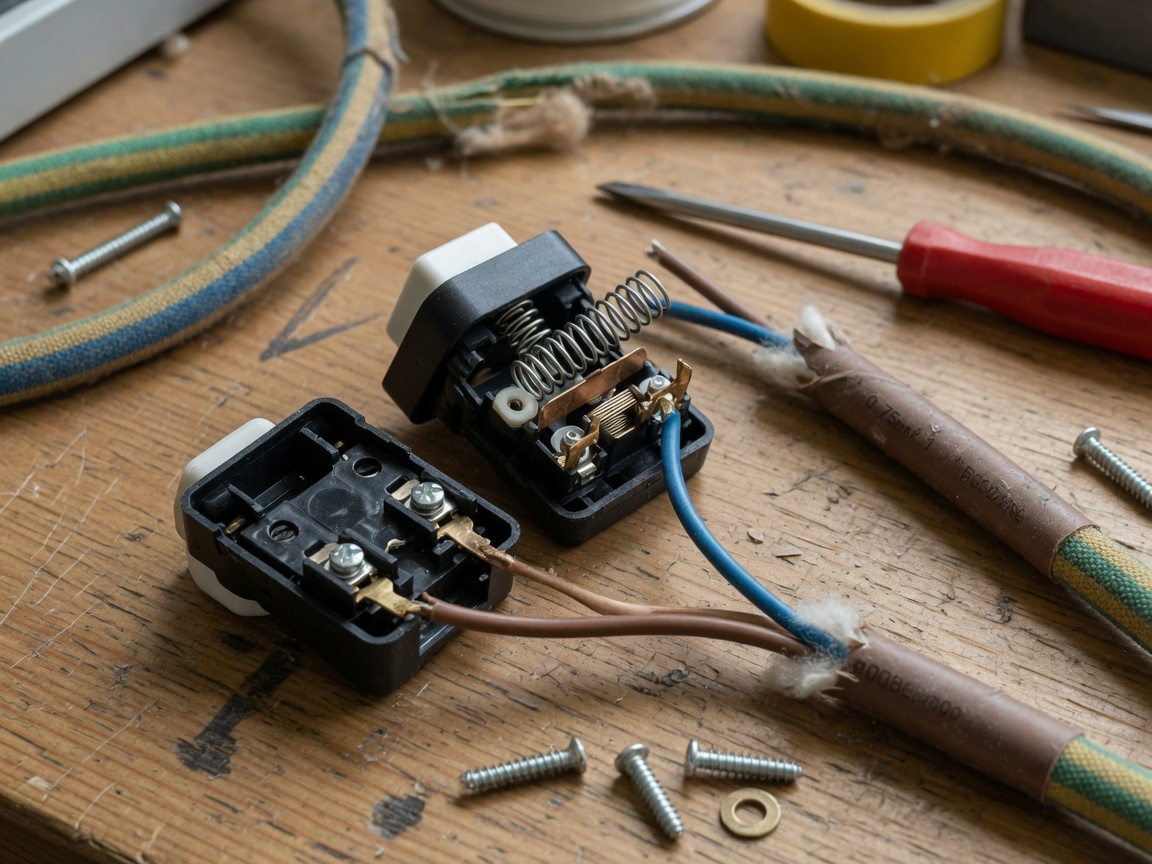
- Open the switch body. Use a flathead screwdriver to prise the halves apart or unscrew the retaining screw. Note how the flex is routed through the housing before disturbing anything.
- Photograph the wiring before disconnecting. A quick photo on your phone takes two seconds and prevents any ambiguity about which wire goes where.
- Disconnect the existing switch. In a standard UK twin-core lamp flex (brown = live, blue = neutral), only the live (brown) conductor should be interrupted by the switch. If you find both conductors are switched, the original wiring was non-compliant — re-wire to switch live only.
- Thread the flex through the new switch body. Ensure the cord grip clamps are positioned correctly on the outer sheath of the flex, not on the individual conductors.
- Connect the conductors. Strip approximately 6 mm of insulation, insert into the terminal block, and tighten firmly. The live (brown) connects to the two switch terminals; the neutral (blue) passes through uninterrupted.
- Close and reassemble the switch body. Ensure no bare conductor is visible and the cord grips are secure.
- Test before full use. Plug into the mains, operate the switch three to four times, and if available, use a socket tester to verify correct polarity before leaving the lamp unattended.
A note on flex sizing: UK lamp flex is almost always 0.5 mm² two-core for loads up to 3 A (approximately 690 W at 230 V). For a standard LED bedside lamp drawing under 15 W, this is entirely adequate. If you are retrofitting a switch onto a high-wattage floor lamp with a halogen or large incandescent bulb, verify the flex rating matches the bulb load before proceeding.
Choosing the right lamp push button for your home
With so many options available — from a basic £2 barrel switch on a marketplaces site to a £25 designer touch switch lamp from a specialist lighting retailer — how do you make a confident decision? The answer comes down to three variables: your lamp type, your bulb technology, and your aesthetic preference.
Matching switch type to lamp and location
Think of choosing a lamp switch a bit like choosing a lock for a door: the mechanism has to match the door (lamp) it is fitted to, not just look right from the outside. A heavy-duty toggle switch rated at 4 A looks impressive but is unnecessary — and physically oversized — for a slim-profile desk lamp with on/off button. Equally, a miniature snap-action push button designed for low-current signalling circuits is entirely wrong for a standard mains lamp, regardless of how neatly it fits the hole.
For a bedroom lamp switch or bedside table light switch, a standard 2 A inline barrel push button in white or black is almost always the correct choice. It is compact, easy to replace, widely available at B&Q, Screwfix, and Amazon UK, and priced accessibly. For a floor lamp button switch where foot operation is expected, choose a design with a rated mechanical endurance of at least 30,000 cycles — check the datasheet, not just the packaging.
Aesthetic and finish considerations for UK interiors
The UK market in 2026 shows a clear trend towards brushed brass and antique bronze finishes for visible lamp hardware, driven by the continued popularity of warm-toned interior design across Pinterest and interior lifestyle platforms. If your lamp has a brass or copper body, a matching brass-finish lamp on/off switch creates a cohesive look. Chrome and nickel suit more contemporary or industrial-style lamps. Plain white and black barrel switches are the most universally available and remain dominant in volume terms — according to near-term 2026 data from UK lighting component distributors, white inline switches account for approximately 58% of unit sales in the home lighting accessories category.
For a truly integrated look, some premium table lamp manufacturers — including those supplying department stores such as John Lewis and Heal's — use recessed push buttons machined from the same material as the lamp base. These are lamp-specific and usually only available as manufacturer spare parts. Always check whether a branded replacement part exists before fitting a generic substitute on a higher-value lamp.
Future-proofing: smart lamp compatibility
It is worth asking whether a purely mechanical lamp push button is the right long-term choice if you use smart home technology. Smart bulbs such as those from Philips Hue or LIFX require constant mains power to remain network-connected — switching them off at the lamp switch removes that power and disables their smart features. If you use smart bulbs, consider leaving the inline switch permanently in the on position and controlling the lamp via the smart home app or a wall-mounted remote. In that case, the lamp push button becomes a safety isolation point rather than a daily control mechanism, and a simple latching inline switch remains the correct hardware choice.
FAQ
Conclusion
The lamp push button is a small component that makes an outsized difference to how reliably and safely your lighting works every day. In 2026, the UK market offers a wider range of switch types, finishes, and smart-compatible options than ever before — but that choice also means more opportunities to buy the wrong product. The key decisions are clear: latching over momentary for standard lamps, LED-compatible ratings to prevent flickering, and UKCA or BS EN 61058 certification to ensure genuine safety compliance.
Whether you are replacing a worn bedside lamp switch, retrofitting a floor lamp button switch, or simply trying to understand what that small barrel inline switch on your table lamp actually is, applying the guidance in this article will lead you to the right product. For deeper technical background on the internal mechanics, the push button switch reference on Wikipedia provides a solid grounding in the underlying contact mechanism principles.
A final point worth making: the cheapest option is rarely the right option for a component that sits in a live mains circuit and operates thousands of times over a lamp's lifetime. A certified, correctly specified lamp push button from a reputable UK supplier — costing perhaps £4 to £8 — is one of the better-value safety investments you can make in your home.
Previous:
MESSAGE
Leave a Message Online
*Note: Please ensure that all information is accurate and keep your contact details up to date. We will get in touch with you as soon as possible.
Contact Information
Contact: Manager Zhang (Business Department)
Phone:+86 0769-86302535-8808
Mobile phone:+86 18025227237
E-mail:hosong@hosong.cn
Address: No. 2, Industrial Road No. 1, Xiajiangcheng, Gaobu Town, Dongguan City, Guangdong Province, China

Scan to add the official account
Learn more about WeCom...
Want to learn more about the company’s products and information?
Guangdong HOSONG Button Manufacturing Co., Ltd.
Phone:+86 18025227237 / +86 0769-86302535
WhatsAPP:+86 18025227237
Email:hosong@hosong.cn
Address: No. 2, Industrial Road No. 1, Xiajiangcheng, Gaobu Town, Dongguan City, Guangdong Province, China
HOSONG International (Hong Kong) Limited
Address: Room 15, 11th Floor, Wah Wai Plaza, No. 1008 Tai Nam Sai Street, Lai Chi Kok, Kowloon, Hong Kong
Phone:0852-30780831
Fax:0852-30775900