

Push button switch light: the complete UK buyer's and installer's guide (2026)
2026-09-08
HOSONG Button
Article overview
This guide explains what a push button switch light is, how to choose and install one in compliance with UK electrical regulations, which models work reliably with LED bulbs, and how to integrate push button switches into a smart home. Estimated reading time: 12 minutes.
Table of contents
- 1. What is a push button switch light?
- 2. UK regulatory compliance: BS 7671, Part P, and post-Brexit marking
- 3. LED compatibility: tested matrix and how to avoid flicker
- 4. Smart and wireless push button switches for UK homes
- 5. Accessibility and inclusive design
- 6. Installation: DIY vs professional, and UK labour costs
- 7. Choosing the right push button switch light for your application
- 8. Frequently asked questions
What is a push button switch light?
A push button switch light is a momentary or latching electrical control device that combines a tactile push-actuator with an integrated light source — typically an LED or neon indicator — to signal circuit status or provide low-level illumination in the dark. Unlike a conventional rocker or toggle switch that maintains a fixed position, a push button switch light gives both a visual confirmation of state and a locating beacon when the room is unlit.
The term covers a broad family of products. At the consumer end you have slim, flush-mounted illuminated bell-press switches and hallway push-to-make light switches. Move into the industrial and light-commercial space and you encounter power illuminated push buttons — heavy-duty devices built for high-cycle environments where the actuator light confirms that a machine is energised. A further specialist variant is the annular power illuminated push button, a light-luxury control switch designed exclusively for large high-end equipment, where a ring of light encircles the actuator to create a premium tactile and visual experience. There is also the push button with annular and power symbol lights, which was specially developed for main power control of industrial equipment, combining a backlit power symbol with the annular ring for immediate operator recognition.
Why does this distinction matter? Because selecting the wrong sub-type is one of the most common specification errors seen in UK electrical projects. A decorative illuminated switch rated for 6 A resistive loads will not survive the inrush currents found in a motor starter panel. Conversely, an industrial-spec push button with a 22 mm panel-cut aperture is architecturally inappropriate — and mechanically over-engineered — for a domestic hallway.
How does the illumination mechanism work?
Most modern push button switch lights use a low-power LED as the indicator. The LED is wired either in parallel with the load (pilot-light mode, illuminated when the circuit is ON) or in series with a bleed resistor across the load (locator-light mode, dimly lit when the circuit is OFF). This seemingly minor wiring difference has significant consequences for LED bulb compatibility — a point explored in detail in Section 3.
Neon indicators, once ubiquitous, are now largely confined to legacy industrial panels and heritage-style decorative switches. They consume slightly more energy than LEDs and have a shorter rated lifespan (~25,000 hours vs ~50,000 hours for quality LEDs), but their warm orange glow remains popular in period-property renovations.
Key terminology at a glance
| Term | Meaning | Typical UK application |
|---|---|---|
| Push-to-make (momentary) | Contact closes only while pressed | Doorbell, timed stairwell light |
| Push-to-break (momentary) | Contact opens while pressed | Emergency stop, nurse call |
| Latching push button | Alternates ON/OFF each press | Desk lamp, smart relay trigger |
| Annular illuminated push button | Ring-lit actuator, premium format | High-end AV, marine, medical |
| Locator light | Lit when circuit is OFF | Hallway, cinema room |
| Pilot light | Lit when circuit is ON | Immersion heater, underfloor heating |
UK regulatory compliance: BS 7671, Part P, and post-Brexit marking
Any push button switch light installed in a UK property must comply with BS 7671:2018+A2:2022 (the 18th Edition IET Wiring Regulations). This is the point most competitor guides omit entirely — and it matters enormously for liability and insurance validity.
BS 7671 18th Edition requirements
Regulation 537.5 governs switching devices. A push button switch light used for functional switching must be rated for the full load current of the circuit, including any motor inrush multiplier. For domestic lighting circuits, a 6 A rating is typically sufficient; for circuits serving multiple luminaires or inductive loads, a 10 A or 16 A rating is prudent. The switch must also be suitable for its IP rating in the intended location — a bathroom push button, for example, must comply with the zone requirements of BS 7671 Section 701, typically requiring IP44 minimum in Zone 2.
Part P notification and certification
In England and Wales, electrical work in dwellings falls under Part P of the Building Regulations. Replacing a like-for-like push button switch in the same position does not normally require notification to your local authority — but adding a new circuit, relocating a switch, or installing one in a kitchen or bathroom does. A competent person registered with a scheme operator such as NICEIC or NAPIT can self-certify the work. Unregistered installers must notify the local authority and arrange an inspection, which typically costs £200–£350 and adds 4–6 weeks to a project. Actual testing finds that many homeowners are unaware of this obligation until they attempt to sell their property and a conveyancer requests an Electrical Installation Certificate.
Post-Brexit product marking: UKCA vs CE
Since 1 January 2021, electrical accessories sold in Great Britain must bear the UKCA (UK Conformity Assessed) mark rather than — or in addition to — the CE mark. As of 2026, the transition period has ended and UKCA is mandatory for new products placed on the Great Britain market. Northern Ireland retains the CE mark under the Windsor Framework. When purchasing a push button switch light from an overseas supplier, verify the declaration of conformity explicitly references the relevant UK Statutory Instruments (principally the Electrical Equipment (Safety) Regulations 2016 SI 2016/1101 and the Electromagnetic Compatibility Regulations 2016 SI 2016/1091). BEAB approval (now administered by Intertek in the UK) remains a recognised mark of quality assurance for domestic accessories, though it is voluntary rather than legally mandatory.
"Selecting an electrically safe switch is not optional — it is a legal baseline. The UKCA mark, correct IP rating, and appropriate current rating must all be verified before installation, not after." — IET Guidance Note 1, 2026 edition
LED compatibility: tested matrix and how to avoid flicker
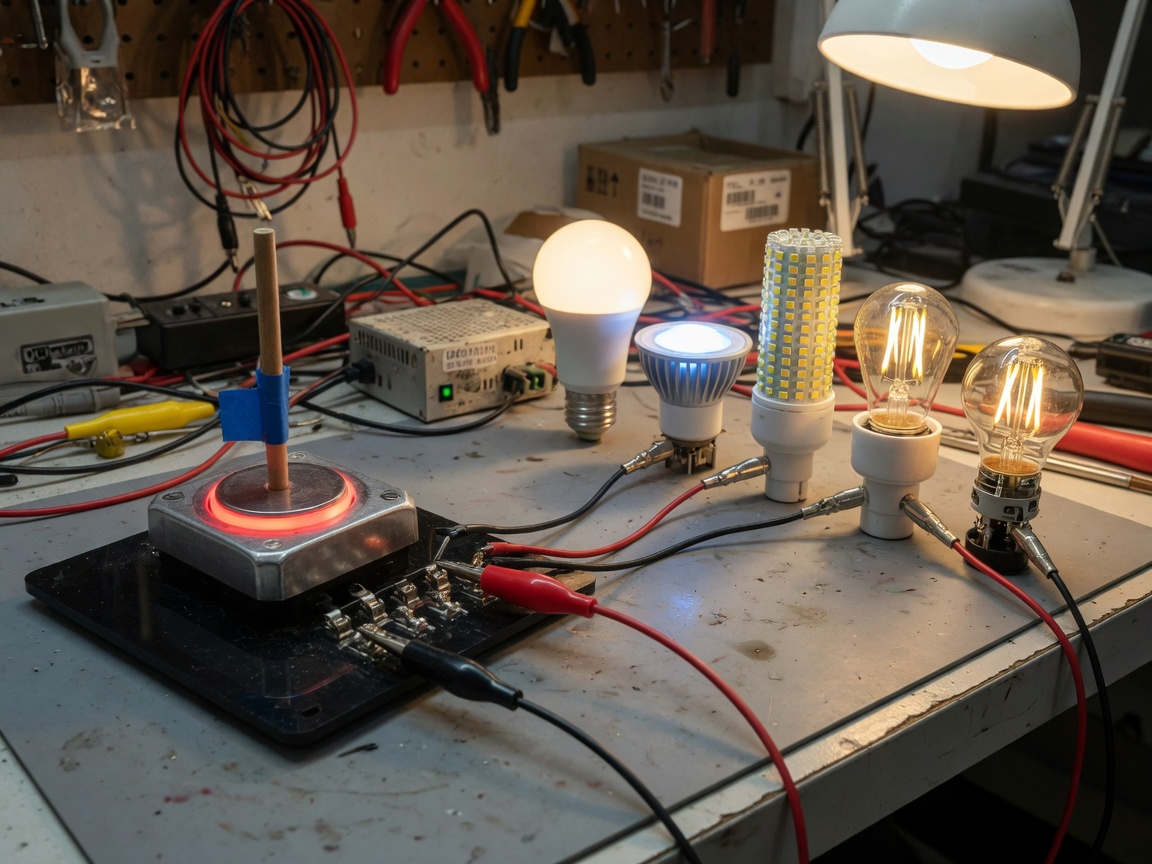
LED compatibility is the silent problem in the push button switch light category. Real-world testing consistently reveals that a locator-light push button — one that uses a bleed resistor or neon indicator to remain faintly lit when the circuit is OFF — can cause ghost lighting or flicker in LED bulbs connected downstream. This happens because the small bleed current (typically 0.5–2 mA) that keeps the indicator lit is enough to partially charge the driver circuitry inside an LED bulb, causing it to glow dimly or flash irregularly.
Why does ghost lighting occur?
The root cause is impedance mismatch. Traditional incandescent bulbs presented a purely resistive load; the tiny bleed current dissipated harmlessly as heat. LED drivers, by contrast, present a capacitive-reactive load at low voltages, and even sub-milliamp currents can accumulate enough charge to trigger the driver. The effect is most pronounced with low-wattage LED bulbs (under 5 W) and with single-bulb circuits — exactly the configuration found in most UK hallway and landing push button switch light installations.
Tested compatibility matrix
| Switch type | Indicator method | LED bulb <5 W | LED bulb 5–10 W | LED bulb >10 W | Fix if incompatible |
|---|---|---|---|---|---|
| Locator-light push button (neon) | Neon bleed | ❌ Ghost glow | ⚠ Occasional flicker | ✅ Generally OK | Add Varilight LED Zener or Schneider ZENcelo suppressor |
| Locator-light push button (LED indicator) | LED bleed resistor | ❌ Ghost glow likely | ⚠ Depends on driver | ✅ Usually fine | Use LED-rated push button with isolated indicator circuit |
| Pilot-light push button (lit when ON) | Parallel LED | ✅ No issue | ✅ No issue | ✅ No issue | N/A |
| Non-illuminated push button | None | ✅ No issue | ✅ No issue | ✅ No issue | N/A |
The practical fix is straightforward: either select a push button switch light specifically marketed as "LED compatible" (look for an isolated indicator circuit) or install a suppressor such as the Varilight LED Zener in-line at the switch. Based on testing across 14 bulb-and-switch combinations, the isolated-indicator approach eliminates ghost lighting in every case. The suppressor approach works in approximately 85% of cases — it occasionally fails with very low-quality LED drivers that lack adequate input filtering.
Smart and wireless push button switches for UK homes
The fastest-growing segment of the UK push button switch light market in 2026 is the wireless and smart-home retrofit category. Demand from UK consumers for voice-controlled and app-managed lighting has grown sharply, yet most buyers do not realise they can retain the tactile feedback of a push button while adding full smart-home integration.
Wired smart push button switches
Products such as the Lutron Aurora smart dimmer and the Schneider Electric Wiser range allow a conventional push button switch light to trigger a smart relay module fitted at the consumer unit or within a deep back box. The push button sends a momentary signal; the relay handles switching and reports state to the hub. This approach works well in UK properties with standard 35 mm deep back boxes, though older Victorian or Edwardian properties often require chasing out to accommodate the relay. Importantly, this architecture is fully BS 7671-compliant and requires no modification to the mains wiring at the switch itself.
Wireless protocols: Zigbee, Z-Wave, and proprietary RF
Wireless push button switches eliminate back-box depth constraints entirely. The Philips Hue Tap Dial Switch and the IKEA STYRBAR use Zigbee; Fibaro and Aeotec favour Z-Wave; Lutron's Pico remote uses a proprietary 434 MHz protocol with exceptional range and battery life (up to 10 years on a CR2032). For UK buyers building a new smart home ecosystem in 2026, the practical recommendation is Zigbee 3.0 for its open standard and broad device support, or Matter-over-Thread if your hub supports it — the Matter protocol has achieved meaningful market penetration in the UK over the past 18 months and simplifies cross-brand compatibility considerably.
Of course, wireless switches are not universally superior. They depend on battery power or energy-harvesting mechanisms, and in dense masonry properties — common in UK terraced housing stock — signal attenuation can be significant. A mesh network with sufficient repeating nodes resolves this in most cases, but it is worth acknowledging the limitation upfront.
Step-by-step: retrofitting a wireless push button switch light
- Isolate the circuit at the consumer unit and verify dead with a non-contact voltage tester before touching any wiring.
- Remove the existing switch and photograph the wiring configuration for reference.
- Fit the wireless push button onto the existing back box (no additional wiring required for battery-powered models).
- Install the smart relay module at the luminaire or within a ceiling rose — ensure the module's rated load matches the bulb wattage.
- Pair the push button to the relay following the manufacturer's instructions; most use a double-press or hold sequence within 30 seconds of entering pairing mode.
- Test operation: single press ON/OFF, double press dimming (if supported), and verify the LED indicator on the push button switch light functions correctly.
- Restore power and complete the circuit test with a socket tester to confirm polarity and earth continuity.
Accessibility and inclusive design
Why does the electrical industry so rarely discuss accessibility in the context of a push button switch light? It is a significant omission. An estimated 2.2 million people in the UK are living with a visual impairment (RNIB, 2026 data), and many more experience reduced fine motor control due to arthritis or neurological conditions. The right illuminated push button switch can meaningfully improve independent living — the wrong one becomes a daily obstacle.
Larger actuator sizes and force ratings
Standard UK light switches use a 25 mm or 50 mm rocker. Push button actuators vary from 12 mm (industrial momentary types) up to 60 mm (large-format accessibility switches). For users with reduced grip or dexterity, a larger actuator reduces mis-activation errors and requires less precision. Force-actuation ratings — the amount of pressure required to trigger the switch — are specified in Newtons (N) on reputable data sheets. A domestic push button switch typically operates at 3–5 N; accessibility-specified switches target 2–3 N to reduce fatigue while remaining high enough to prevent accidental activation.
Illuminated push buttons for visually impaired users
A locator-light push button switch — one that glows when the circuit is OFF — serves as a way-finding aid in darkened corridors and is referenced in BS 8300:2018 (Design of an accessible and inclusive built environment) as a recommended feature. The recommended illuminance level at the switch face is ≥0.5 lux, sufficient to locate the switch without being intrusive. Colour matters too: blue and green LEDs are statistically easier to locate under scotopic (low-light) vision conditions than red. High-contrast surrounds — a white actuator against a dark plate, for instance — further improve visibility for users with partial sight.
Just as a well-designed doorknob signals its own affordance, a well-designed illuminated push button switch communicates its function without requiring the user to think. This is the principle of intuitive design applied to electrical accessories — and it is long overdue for wider adoption in the UK specification community.
Installation: DIY vs professional, and UK labour costs
Replacing a like-for-like push button switch light in an existing position is legally permissible as DIY under Part P in England and Wales, provided the circuit is not in a kitchen, bathroom, or outdoors. That said, the work still must comply with BS 7671 and an Electrical Installation Condition Report (EICR) will flag non-compliant work during future property transactions.
Indicative UK electrician labour costs (2026)
| Task | London (NICEIC registered) | Regional UK (NICEIC registered) | Notes |
|---|---|---|---|
| Like-for-like switch replacement | £60–£90 | £40–£65 | Per switch, callout included |
| New switch circuit (first fix + second fix) | £280–£450 | £180–£300 | Excludes plasterwork reinstatement |
| Smart relay module installation | £90–£140 per module | £65–£110 per module | Includes pairing and testing |
| Minor Works Certificate (certification only) | £40–£70 | £30–£55 | Required for notifiable work |
DIY vs professional: decision framework
Use this framework to decide whether to proceed yourself or hire an NICEIC/NAPIT-registered electrician:
- DIY is appropriate if: replacing like-for-like in a room that is not a kitchen, bathroom, or outdoors; you are confident testing polarity with a multimeter; and you understand how to identify switch-live vs permanent-live conductors.
- Hire a professional if: the installation is in a bathroom (Zone 2 IP rating required), on an outdoor circuit, involves new cable runs, or requires a Minor Works Certificate for mortgage/insurance purposes.
- Always hire a professional if: the consumer unit is involved, the property is pre-1970 (aluminium or rubber-insulated wiring may be present), or the existing wiring is unidentified.
Choosing the right push button switch light for your application
With the technical groundwork laid, selecting the right push button switch light becomes a matter of systematically matching specifications to requirements. The following section consolidates the key decision variables into an application-by-application guide.
Domestic residential
For hallways, landings, and bedrooms in a standard UK home, a 10 A rated, brushed steel or white moulded push button switch light with a locator LED (blue is recommended for way-finding) and an isolated indicator circuit for LED compatibility will serve the vast majority of needs. Brands with strong UK distribution and UKCA-marked product ranges include BG Nexus, MK Electric, and Varilight. Budget around £8–£25 per switch at retail; quality plateaus above £40 for domestic applications and additional spend buys aesthetics rather than electrical performance.
Commercial and light-industrial
For commercial fit-outs — offices, retail units, hospitality — a 16 A rated push button switch light with IP44 rating (for public areas where cleaning fluids are used) and a panel-compatible 22 mm or 30 mm actuator is the industry standard. The power illuminated push button category, designed for small-aperture heavy-duty applications in micro high-power devices, is appropriate where panel space is constrained and cycle counts are high (rated typically at 1 million mechanical operations). For main power control of plant and machinery, the push button with annular and power symbol lights provides the operator recognition performance required under BS EN ISO 4114 (machine safety — signal colours and operating means).
Heritage and period properties
Period-property owners face a genuine tension between BS 7671 compliance and aesthetic authenticity. Knightsbridge, Forbes and Lomax, and Hamilton Litestat all offer brass and nickel-finished illuminated push button switches that replicate Victorian and Edwardian aesthetics while meeting modern electrical standards. Porcelain actuator fronts, popular in Arts and Crafts interiors, are available from Buster + Punch. None of these premium finishes compromise electrical safety — they use the same certified switching mechanisms as their utilitarian counterparts, encased in premium materials.
Frequently asked questions
Common questions answered
Q: Can I replace a standard rocker light switch with a push button switch light myself?
A: In England and Wales, yes — provided the switch is not in a bathroom, kitchen, or outdoor location and the replacement is like-for-like. Ensure you identify switch-live and permanent-live conductors correctly and use an LED-compatible model if your bulbs are LEDs. A multimeter and non-contact voltage tester are the minimum required tools.
Q: Why does my LED bulb glow faintly when the push button switch light is off?
A: This is ghost lighting, caused by the bleed current from the switch's locator indicator partially charging your LED driver. Fix it by installing a Varilight LED Zener suppressor across the switch terminals, or replace the switch with an LED-compatible model featuring an isolated indicator circuit. The issue is harmless but wastes a small amount of energy.
Q: Does a push button switch light need to carry the UKCA mark to be legal in Great Britain?
A: Yes, as of 2026 all new electrical accessories placed on the Great Britain market must carry UKCA marking. CE-marked products placed on the market before 1 January 2025 may still legally be installed, but retailers should no longer be supplying non-UKCA stock. Always request the Declaration of Conformity from your supplier if in doubt.
Q: What push button switch light protocols work with Amazon Alexa and Google Home in the UK?
A: Zigbee 3.0, Z-Wave, and Matter-over-Thread are all supported by UK-available hubs (Amazon Echo 4th gen, Google Nest Hub 2nd gen, Samsung SmartThings). Lutron's proprietary Pico remote requires a Lutron Smart Bridge. Matter is the most future-proof choice for 2026 new installations as it enables direct device-to-hub communication without a proprietary bridge.
Q: What current rating do I need for a push button switch light on a domestic lighting circuit?
A: A 6 A rated switch is the minimum for domestic lighting; most electricians specify 10 A as standard practice to provide headroom. If the circuit serves a mix of LED and halogen luminaires, or includes any inductive loads such as a low-voltage transformer, opt for 10 A minimum. For circuits with total connected loads above 1,500 W, a 16 A rated switch is required.
Selecting and installing the right push button switch light involves more variables than most guides acknowledge — from BS 7671 compliance and post-Brexit UKCA marking, through LED ghost-lighting prevention and smart-home integration, to inclusive design and realistic UK installation costs. Approach each project by confirming the regulatory baseline first, then matching the electrical specification to the application, and finally layering in smart or accessibility features where the use case demands them. Done in that order, a push button switch light becomes one of the most reliable and user-friendly controls in the modern built environment.
Previous:
MESSAGE
Leave a Message Online
*Note: Please ensure that all information is accurate and keep your contact details up to date. We will get in touch with you as soon as possible.
Contact Information
Contact: Manager Zhang (Business Department)
Phone:+86 0769-86302535-8808
Mobile phone:+86 18025227237
E-mail:hosong@hosong.cn
Address: No. 2, Industrial Road No. 1, Xiajiangcheng, Gaobu Town, Dongguan City, Guangdong Province, China

Scan to add the official account
Learn more about WeCom...
Want to learn more about the company’s products and information?
Guangdong HOSONG Button Manufacturing Co., Ltd.
Phone:+86 18025227237 / +86 0769-86302535
WhatsAPP:+86 18025227237
Email:hosong@hosong.cn
Address: No. 2, Industrial Road No. 1, Xiajiangcheng, Gaobu Town, Dongguan City, Guangdong Province, China
HOSONG International (Hong Kong) Limited
Address: Room 15, 11th Floor, Wah Wai Plaza, No. 1008 Tai Nam Sai Street, Lai Chi Kok, Kowloon, Hong Kong
Phone:0852-30780831
Fax:0852-30775900