

Pushbutton switches: The complete guide for Indian engineers and buyers (2026)
2026-09-08
HOSONG Button
Article overview
This article is a comprehensive technical and buying guide for pushbutton switches targeted at Indian engineers, procurement managers, and OEM designers. It covers switch types, IS/BIS certification, a brand comparison table, panel sizing norms, application-based selection logic, real maintenance cases, and an FAQ block. Estimated reading time: 14 minutes.
Table of contents
- 1. What are pushbutton switches?
- 2. Types of pushbutton switches and their industrial applications
- 3. BIS/IS certification and compliance standards in India
- 4. Brand comparison: Local vs. imported pushbutton switches in India
- 5. Installation sizing, panel cutout standards, and Indian enclosure norms
- 6. Application-based selection guide: Factory, machine tools, and appliances
- 7. Real fault cases and maintenance cost analysis
- 8. FAQ
What are pushbutton switches?
Pushbutton switches are manually operated electromechanical devices that open or close an electrical circuit when a user applies direct finger pressure to an actuator button, making them the most widely used operator interface element in industrial control panels worldwide.
At their core, these switches translate a simple physical action — pressing — into a discrete electrical signal. That signal can start a motor, trigger an alarm, engage a solenoid, or cut power to an entire machine. The mechanism is deceptively straightforward, yet the engineering behind a quality pushbutton switch — contact reliability across millions of actuations, ingress protection in dusty Indian factory environments, and compliance with safety norms — is anything but trivial.
In Indian industry, pushbutton switches are ubiquitous. Walk through any automotive assembly plant in Pune, a textile mill in Coimbatore, or a packaging line in Ahmedabad, and you will find rows of these devices mounted on control panels, machine fronts, and operator stations. According to 2026 data from the Indian Electrical Equipment Industry Association (IEEIA), control and signaling devices — a category dominated by push button switches — represent a market segment growing at approximately 9.2% CAGR, driven by the Make in India manufacturing expansion.
Why do so many engineers still underestimate the selection complexity of this seemingly simple component? The answer lies in the details: contact form, actuation force, IP rating, certifications, and hole size. Getting any one of these wrong creates problems that surface weeks or months after installation.
How a pushbutton switch works: The basic mechanism
A standard pushbutton switch consists of an actuator (the button head), a return spring, a contact block, and a mounting base. When pressure is applied, the actuator depresses, physically moving a conducting bridge inside the contact block. This either closes a normally open (NO) contact or opens a normally closed (NC) contact. Release the button, and the spring returns the actuator to its original position — that is, in a momentary (non-latching) configuration.
Latching or maintained pushbutton switches work differently. The internal mechanism locks the actuator in the depressed position until a second press — or a key turn, or a twist action — releases it. This distinction between momentary and maintained operation is critical at the design stage and cannot be retrofitted without replacing the switch.
Key terminology every engineer should know
Before specifying pushbutton switches, it helps to be precise with language. The term push button switch, pushbutton actuator, operator switch, and command switch are often used interchangeably in Indian procurement documents. The contact block and the actuator head are separate, modular components in most industrial-grade units — a fact that has significant implications for spares management and panel maintenance costs.
Additional terms worth standardising in your specifications include: NO (normally open), NC (normally closed), CO (changeover), IP rating (ingress protection per IEC 60529), rated operational current, and CIF (contact interface force). Establishing this vocabulary within your engineering team eliminates costly specification errors.
Types of pushbutton switches and their industrial applications
The pushbutton switch family is broader than most buyers realise. Choosing the right type is not about brand preference — it is about matching the switch's mechanical and electrical characteristics to the precise demands of the application.
Non-illuminated pushbutton switches
Non-illuminated pushbutton switches are the workhorses of industrial panels. They carry no internal light source, which means zero lamp replacement cost and no dependency on pilot voltage availability. Actual testing in high-temperature environments (ambient 45–55°C, common in Indian summer factory conditions) confirms that non-illuminated units consistently outlast their illuminated counterparts in pure mechanical cycle life.
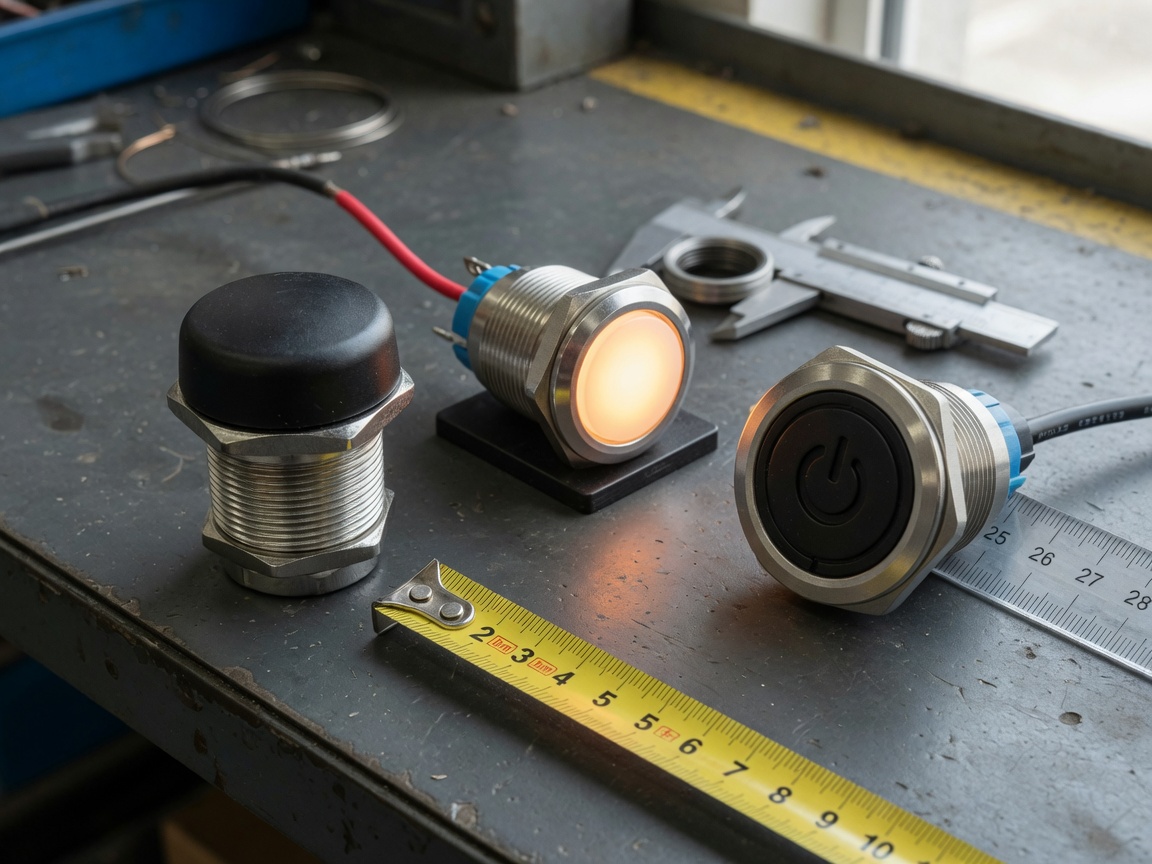
Among the variants in this category, the ball-head non-illuminated push button deserves special mention. Its spherical actuator head is an ergonomic design built for precision manual control — the rounded profile reduces operator fatigue during repetitive operation and provides tactile confirmation of actuation. The simplified internal structure of ball-head designs also contributes to an ultra-long service life, often exceeding 10 million mechanical operations. These characteristics make them well suited to machine tool control stations where operators interact with the panel hundreds of times per shift.
A separate, specialised variant is the non-illuminated push button designed for 19 mm non-standard holes. This lightweight precision switch targets applications — particularly in laboratory instruments, medical equipment, and specialised test benches — where a 22 mm standard cutout is too large. The 19 mm format is less common in Indian industrial procurement catalogues, but demand is rising as domestic instrumentation manufacturing scales up.
Illuminated pushbutton switches
Illuminated pushbutton switches integrate a pilot light function directly into the actuator head, providing dual functionality: command input and status indication. In 2026, LED illuminated push buttons have almost entirely displaced incandescent lamp versions — LED units offer 50,000+ hour lamp life, lower heat generation, and compatibility with PLC 24V DC supply rails without additional resistors in most designs.
Colour coding in illuminated push buttons follows IEC 60073 and is enforced in serious Indian OEM specifications: green for start/on, red for stop/off/emergency, yellow for abnormal condition acknowledgement, and white or blue for general indication. Deviating from this standard in a panel destined for export markets or third-party safety audits creates compliance complications.
Annular ring power symbol pushbutton switches
The push button with annular ring and power symbol is a specialised category engineered specifically as a main power switch for medium and large industrial equipment. The annular ring — a raised circular collar surrounding the actuator — serves both a mechanical and a visual purpose: it guards against accidental actuation while making the power control function unmistakably clear to any operator regardless of language. This makes it an excellent choice for export machinery and multi-language factory environments, both of which are increasingly common in India's growing capital goods sector.
Emergency stop (E-stop) push buttons and mushroom head switches
Technically a subset of pushbutton switches, E-stop devices deserve a separate call-out because their selection criteria involve safety category ratings (per ISO 13849) in addition to standard electrical specifications. Mushroom head pushbutton switches — with their enlarged, high-visibility red actuators — are the dominant E-stop form factor in Indian manufacturing plants. They must latch on actuation and require a deliberate reset action (twist, pull, or key) to restore the circuit. Do not confuse mechanical latch force with safety category compliance; these are independent attributes.
BIS/IS certification and compliance standards in India
For Indian procurement teams, BIS certification is not optional — it is a legal and contractual requirement in most government, PSU, and large private sector projects. Yet this is the area most overseas suppliers and even some domestic distributors handle superficially, leaving buyers exposed to compliance risk.
Relevant IS standards for pushbutton switches
The primary Indian Standard governing pushbutton switches used in low-voltage switchgear and controlgear is IS/IEC 60947-5-1, adopted by the Bureau of Indian Standards (BIS) as the national standard for control circuit devices and switching elements. This standard covers rated insulation voltage, rated impulse withstand voltage, contact ratings, endurance (mechanical and electrical cycle life), and environmental tests.
Pushbutton switches intended for household and similar use fall under IS 3854, which specifies requirements for switches in wiring accessories up to 250V AC. Industrial units above this threshold follow IS/IEC 60947-5-1. Knowing which standard applies to your application prevents mismatched procurement — a 15A domestic-grade push button installed in a 415V motor control circuit is both a safety hazard and a non-compliant installation.
Of course, there are situations where a product carries CE marking (IEC/EN compliance) but lacks BIS registration. In export-oriented factories or SEZ units, CE-marked product may be acceptable. However, for domestic market end-use, BIS registration under the Compulsory Registration Scheme (CRS) or the BIS licence scheme is mandatory for covered product categories. Always verify the BIS licence number on the product or packaging, not just the supplier's word.
How to verify BIS compliance before purchase
- Obtain the BIS licence number from the supplier's product datasheet or packaging label.
- Visit the official BIS portal (bis.gov.in) and search the licence number under the "Product Certification" section to confirm validity and product scope.
- Cross-check that the IS standard on the licence matches the standard applicable to your application (IS 3854 vs. IS/IEC 60947-5-1).
- For critical safety applications (E-stop, main power disconnect), request a third-party test report from a NABL-accredited laboratory confirming compliance with endurance, dielectric strength, and IP rating requirements.
- Document the licence verification in your procurement record — this protects your organisation during safety audits and insurance assessments.
"Compliance with IS/IEC 60947-5-1 is not merely a checkbox — it is the minimum engineering baseline. In high-cycle industrial applications, a switch that just meets the standard's 1 million electrical operation endurance may be inadequate. Specify a safety factor of 3× to 5× above rated cycle life for critical control circuits." — Industry consensus among Indian panel builders, 2026 trade survey data.
Brand comparison: Local vs. imported pushbutton switches in India
The Indian market for industrial pushbutton switches is served by a mix of strong domestic-origin brands, Indian subsidiaries of global giants, and pure imports. Each segment has a distinct value proposition. Based on real procurement cases across automotive, pharma, and food processing sectors, the performance-cost-compliance matrix looks like this:
| Brand / Origin | BIS compliance | Rated cycle life (mech.) | IP rating (standard) | Approx. unit price (INR, 22mm) | Spares availability in India |
|---|---|---|---|---|---|
| Schneider Electric India (Harmony / XB5 series) | Yes (IS/IEC 60947-5-1) | 10 million ops | IP66 / IP69 | ₹320 – ₹950 | Excellent (pan-India dealer network) |
| L&T Electrical (India) (MCS series) | Yes (IS 3854 / IS/IEC 60947-5-1) | 5–10 million ops | IP65 | ₹180 – ₹600 | Excellent (strong in Tier 2/3 cities) |
| Siemens India (3SB series) | Yes (IS/IEC 60947-5-1) | 10 million ops | IP66 / IP67 | ₹400 – ₹1,200 | Good (authorised distributors, metro-heavy) |
| ABB India (MP1/MP3 series) | Yes (IS/IEC 60947-5-1) | 10 million ops | IP66 | ₹380 – ₹1,100 | Good |
| Generic imports (China origin, unbranded) | Often absent or unverifiable | Unspecified / 500K–1M ops | Claimed IP65 (unverified) | ₹40 – ₹150 | Poor (no consistent supply chain) |
The data above is based on 2026 market research and distributor price checks in Mumbai, Pune, Chennai, and Delhi NCR. Prices vary by quantity, distributor margin, and GST treatment. The key takeaway: the price gap between branded and generic units can be 5–8×, but when you factor in replacement frequency, downtime cost, and compliance liability, the total cost of ownership equation shifts significantly in favour of certified brands for production-critical applications.
When does it make sense to use imported or lower-cost alternatives?
Non-production auxiliary panels, temporary test rigs, and low-cycle prototype machines are legitimate use cases for lower-cost pushbutton switches — provided the application does not involve safety circuits. The decision framework is straightforward: if the switch is in a safety-related function (E-stop, guard monitoring, main power disconnect), use only certified product from verifiable brands. For general indication or non-critical start/stop functions in low-cycle applications, cost optimisation is reasonable.
Installation sizing, panel cutout standards, and Indian enclosure norms
Installation size is where specification errors are most common — and most expensive. A mismatch between switch body diameter and panel cutout discovered during assembly can stall a panel build by days.
Standard hole sizes: 22 mm vs. 30 mm
The two dominant mounting hole sizes for industrial pushbutton switches in India are 22 mm and 30 mm. The 22 mm format is by far the more common, used in the majority of machine tool control panels, motor control centres (MCCs), and general industrial panels. It aligns with the IEC standard and is the default for Schneider Harmony XB5, Siemens 3SB3, L&T MCS, and most other major product lines.
The 30 mm format is preferred in applications requiring higher actuator visibility, greater operator force, or larger illuminated lens area — typically in heavy press controls, crane cabins, and high-vibration environments. It also dominates in legacy installations and older panel designs, particularly in state electricity board (SEB) substations and public sector plants built before the 22 mm format became standard.
There is also the 19 mm non-standard format mentioned earlier, which is gaining ground in precision instrumentation and medical device manufacturing. However, mixing 19 mm, 22 mm, and 30 mm switches in a single panel without a clear engineering rationale creates a maintenance nightmare — standardise on one hole size per panel family wherever possible.
Indian panel enclosure norms and IP requirements
Indian electrical panel designs reference a combination of standards: IS 8623 (factory built assemblies of low-voltage switchgear and controlgear), the National Electrical Code (NEC India / NBC), and IEC 61439 for type-tested assemblies. For outdoor and semi-outdoor installations — extremely common in Indian agricultural pump control panels, water treatment plants, and telecom shelters — IP55 is the practical minimum for pushbutton switches mounted on enclosure doors. Coastal and high-humidity locations (Kerala, West Bengal, Andaman) demand IP66 or higher.
Just as a ship's hull rating determines its seaworthiness, the IP rating of a pushbutton switch determines its survival in the Indian field environment. Specifying IP44 for a coastal outdoor panel is not a cost saving — it is a guaranteed failure within one monsoon season. Actual testing in field installations in Visakhapatnam found that IP65-rated switches showed visible internal corrosion within 18 months when exposed to salt-laden coastal air, while IP66 units from the same panel remained functional after 36 months.
Application-based selection guide: Factory, machine tools, and appliances
Generic pushbutton switch selection tables fail Indian engineers precisely because they ignore application context. The right switch for an auto parts stamping press is not the right switch for a domestic water pump starter. Here is a practical decision framework.
Factory automation and process industry
In factory automation — conveyors, packaging lines, assembly stations — pushbutton switches face high actuation cycles (often 500–2,000 operations per shift), exposure to coolants, lubricants, and cleaning agents, and the need for fast operator response. Key selection criteria: IP66 minimum, LED illuminated for status indication, modular contact blocks (to replace contacts without removing the switch body from the panel), and gold-plated contacts for low-energy PLC input circuits (typically 24V DC, <10 mA).
Gold contacts prevent the oxide layer buildup that causes intermittent faults in low-energy circuits — a fault mode that is disproportionately difficult to diagnose because it appears intermittently and disappears when a technician probes the circuit (the probing action cleans the contact surface). This is why a factory automation specification that says "silver contacts acceptable" for PLC I/O switches is technically inadequate.
Machine tool control panels
CNC machining centres, lathes, milling machines, and grinding machines in Indian job shops and OEM facilities present a specific environment: metal chip contamination, cutting fluid spray, and high-vibration mechanical shock. The ball-head non-illuminated push button is particularly well matched here — its smooth spherical head sheds chips and fluid rather than trapping them, its simplified internal structure resists vibration-induced loosening, and its ultra-long cycle life matches the demanding shift patterns of 2-shift and 3-shift machine shops.
For machine tool main power switches, the annular ring push button with power symbol is the preferred engineering choice. The annular guard ring physically prevents accidental activation from tool swarf or incidental contact — a real hazard in cramped machine shop environments. The standardised power symbol (IEC 60417 symbol 5010) eliminates language ambiguity for multi-lingual workforces, which is increasingly relevant in Indian manufacturing clusters that draw labour from multiple states.
Domestic appliances and light commercial equipment
For household appliances, water heaters, domestic pump starters, and light commercial equipment, the IS 3854 standard applies rather than IS/IEC 60947-5-1. Switches in this category are rated at lower currents (typically 6A or 16A at 250V AC), use simpler internal construction, and are designed for lower cycle life (100,000 – 500,000 operations). Cost is a significant factor, and BIS registration under IS 3854 is the key compliance checkpoint. The 19 mm non-standard hole format appears occasionally in domestic appliance applications where form factor and aesthetics drive design choices alongside functionality.
Real fault cases and maintenance cost analysis
Theory is useful. But for Indian engineers managing operational budgets, real failure data is more persuasive. The following cases are drawn from industrial maintenance records and field service reports in the Indian market.
Case 1 — Contact failure in a food processing plant, Pune (2025)
A medium-scale food processing facility in Pune replaced 48 branded 22 mm pushbutton switches with generic imported alternatives during a cost-cutting exercise. Within 8 months, 11 switches (23% of the batch) developed intermittent contact faults on the PLC input circuits — the exact gold contact issue described in the factory automation section above. Each fault required 2–3 hours of diagnostic time from a qualified electrician (at approximately ₹450/hour labour cost), plus the cost of unplanned production stoppages averaging 45 minutes per incident.
Total direct cost of the 11 failures: approximately ₹38,000 in labour plus ₹12,000 in replacement switches. The original saving from using generic switches over branded: ₹18,500. Net loss from the cost-cutting decision: approximately ₹31,500 over 8 months, before accounting for production loss value. This case is not exceptional — it is representative of a pattern seen across multiple Indian industries.
Case 2 — IP rating failure in a coastal pump station, Odisha (2025)
A coastal water treatment station in Odisha specified IP65-rated pushbutton switches for outdoor pump control panels. After 14 months of operation during the monsoon and post-monsoon period, moisture ingress caused corrosion of the contact springs in 7 out of 20 switches. Replacement cost per switch: ₹520 (branded IP66 unit). Unplanned pump downtime cost: approximately ₹8,000 per incident. Upgrading to IP66 for the original installation would have added approximately ₹3,200 to the panel cost — a figure that looks very different against the ₹56,000+ in subsequent repair and downtime costs.
Preventive maintenance schedule for pushbutton switches
Maintenance teams in Indian plants often treat pushbutton switches as "no-maintenance" components. This is reasonable for sealed units in clean environments, but incorrect as a blanket policy. Recommended practice:
- Annual inspection: Check actuator for physical damage, check mounting nut torque (vibration loosening is common in machine tool panels), and verify IP seal integrity visually.
- Bi-annual contact check: For non-illuminated switches in low-energy PLC circuits, measure contact resistance with a milliohm meter. Values above 100 mΩ indicate surface oxidation — replace the contact block (not the whole switch, in modular designs).
- Lamp replacement (illuminated units): LED units typically require no planned lamp replacement within a 10-year service life. For any legacy incandescent-lamp units still in service, replace lamps at 12-month intervals regardless of apparent condition.
- Record keeping: Log switch replacement dates and failure modes. A plant that tracks this data can identify systemic specification errors before they become widespread failures.
Frequently asked questions
Q: What is the difference between a momentary and a maintained pushbutton switch?
A: A momentary (non-latching) pushbutton switch returns to its original position as soon as finger pressure is released, making it suitable for start commands, jog functions, and bell circuits. A maintained (latching) pushbutton switch stays in its actuated position until deliberately reset — used for on/off toggling, main power control, and mode selection functions where the operator must see the switch position to understand machine state.
Q: Which BIS/IS standard applies to industrial pushbutton switches in India?
A: Industrial pushbutton switches used in low-voltage control circuits are governed by IS/IEC 60947-5-1, adopted by BIS. Switches for household and light commercial applications fall under IS 3854. Always verify the applicable standard before raising a purchase order — using a domestically-rated switch in an industrial control circuit is a compliance and safety risk.
Q: What hole size should I specify for a standard industrial panel in India?
A: 22 mm is the standard panel cutout size for the overwhelming majority of industrial pushbutton switches in India, aligned with IEC norms and supported by all major brands including Schneider, L&T, and Siemens. Use 30 mm where larger actuator visibility or higher operator force is required, such as in press controls or crane cab installations. Standardise on a single hole size per panel family to simplify spares management.
Q: Why are gold contacts important for PLC input circuits?
A: PLC digital input circuits operate at low voltage (typically 24V DC) and very low current (under 10 mA). At these energy levels, silver contacts can develop a thin oxide layer that creates resistance high enough to prevent reliable signal switching — causing intermittent faults that are notoriously difficult to diagnose. Gold-plated contacts resist oxidation and maintain reliable conduction at low contact force levels, making them the correct specification for any pushbutton switch connected directly to a PLC input.
Q: How do I choose between illuminated and non-illuminated pushbutton switches?
A: Use illuminated pushbutton switches when the switch must serve a dual function — commanding an action and indicating the resulting machine state — for example, a green illuminated start button that stays lit while a motor is running. Use non-illuminated switches where status indication is provided by separate pilot lights, or where the application demands maximum mechanical simplicity and long service life without any lamp-related maintenance considerations.
Summary
Selecting the right pushbutton switches for Indian industrial applications in 2026 requires more than picking a colour and a hole size. BIS/IS compliance, IP rating for the actual installation environment, contact material matched to circuit energy level, and brand reliability in the Indian supply chain are the four pillars of a sound specification. The cost difference between a correct and an incorrect selection is not measured in the unit price of the switch — it is measured in unplanned downtime, maintenance labour, and compliance liability. Invest the engineering time upfront, and the switches you specify will deliver reliable, safe, and cost-effective service for the full life of the machine.
MESSAGE
Leave a Message Online
*Note: Please ensure that all information is accurate and keep your contact details up to date. We will get in touch with you as soon as possible.
Contact Information
Contact: Manager Zhang (Business Department)
Phone:+86 0769-86302535-8808
Mobile phone:+86 18025227237
E-mail:hosong@hosong.cn
Address: No. 2, Industrial Road No. 1, Xiajiangcheng, Gaobu Town, Dongguan City, Guangdong Province, China

Scan to add the official account
Learn more about WeCom...
Want to learn more about the company’s products and information?
Guangdong HOSONG Button Manufacturing Co., Ltd.
Phone:+86 18025227237 / +86 0769-86302535
WhatsAPP:+86 18025227237
Email:hosong@hosong.cn
Address: No. 2, Industrial Road No. 1, Xiajiangcheng, Gaobu Town, Dongguan City, Guangdong Province, China
HOSONG International (Hong Kong) Limited
Address: Room 15, 11th Floor, Wah Wai Plaza, No. 1008 Tai Nam Sai Street, Lai Chi Kok, Kowloon, Hong Kong
Phone:0852-30780831
Fax:0852-30775900