

Push button switches explained: types, uses, and how to choose the right one
2026-09-30
HOSONG Button
Article overview
This guide explains push button switches in full technical detail — covering types, UK compliance standards, IP and ATEX ratings, wiring configurations, brand comparisons, and sustainability obligations for UK procurement teams in 2026.
Table of contents
- 1. What are push button switches?
- 2. Types of push button switches: a complete breakdown
- 3. UK standards and compliance: what engineers must know in 2026
- 4. IP ratings and ATEX: choosing the right protection for UK environments
- 5. Push button switch wiring: configurations and practical guidance
- 6. Brand comparison: Omron, Schneider Electric, Siemens, and ABB
- 7. Sustainability, RoHS, and REACH: what UK buyers need to consider post-Brexit
- 8. How to choose the right push button switch: a step-by-step guide
- 9. FAQ
What are push button switches?
Push button switches are electromechanical devices that open or close an electrical circuit when manually pressed, available in momentary (self-resetting) and latching (maintained) configurations for control, signalling, and safety applications. They appear in everything from industrial control panels and consumer appliances to automotive dashboards and home automation systems — making them one of the most universal components in electrical engineering.
Despite their apparent simplicity, specifying the wrong push button switch for a given application can result in premature failure, regulatory non-compliance, or — in safety-critical environments — genuine hazard. The variety is broader than many buyers realise: a basic tactile switch soldered to a PCB and a 22 mm panel mount switch rated for 10 A at 600 V are both "push button switches," yet they serve entirely different functions and demand completely different selection criteria.
According to recent 2026 market research, the global push button switch market is valued at approximately £33 billion (equivalent), with industrial automation accounting for over 38% of total demand. That scale reflects just how embedded these components are across every vertical — and why getting the specification right matters commercially as well as technically.
Why the right terminology matters
Terminology confusion is surprisingly common. A momentary contact switch or push to make switch describes the same function as a normally open push button switch — all close the circuit only while pressed. Conversely, a normally closed push button switch holds a completed circuit until actuated, opening it on press. Conflating these two conventions during procurement or wiring design is one of the most frequent errors encountered in practice. For a comprehensive background, refer to this push button switches overview on Wikipedia.
Momentary vs latching: the core distinction
A momentary push button switch returns to its default state as soon as pressure is released — ideal for start/stop commands, doorbells, or keyboard inputs. A latching push button switch (sometimes called a maintained-contact or alternate-action switch) stays in its actuated position until pressed again. Real-world testing confirms that latching designs experience higher mechanical wear over long duty cycles because the retaining mechanism accumulates fatigue stress differently from a simple spring-return actuator. Knowing this distinction upfront narrows your specification considerably.
Types of push button switches: a complete breakdown
There are six principal categories of push button switches in commercial use in 2026, each optimised for distinct operating conditions. Understanding them as a structured taxonomy — rather than an undifferentiated list — is the fastest route to confident selection.
Standard momentary and latching switches
The workhorse of industrial and commercial installations. Standard panel mount switches typically ship in 16 mm, 19 mm, or 22 mm mounting hole diameters — 22 mm being the near-universal standard for industrial control panels in the UK, compatible with enclosure cutouts from major DIN-rail cabinet manufacturers. Non-illuminated versions offer simplified structure, reduced parts count, and — when using a ball-head actuator design — exceptional service life exceeding 1,000,000 mechanical operations under rated conditions.
Illuminated push button switches
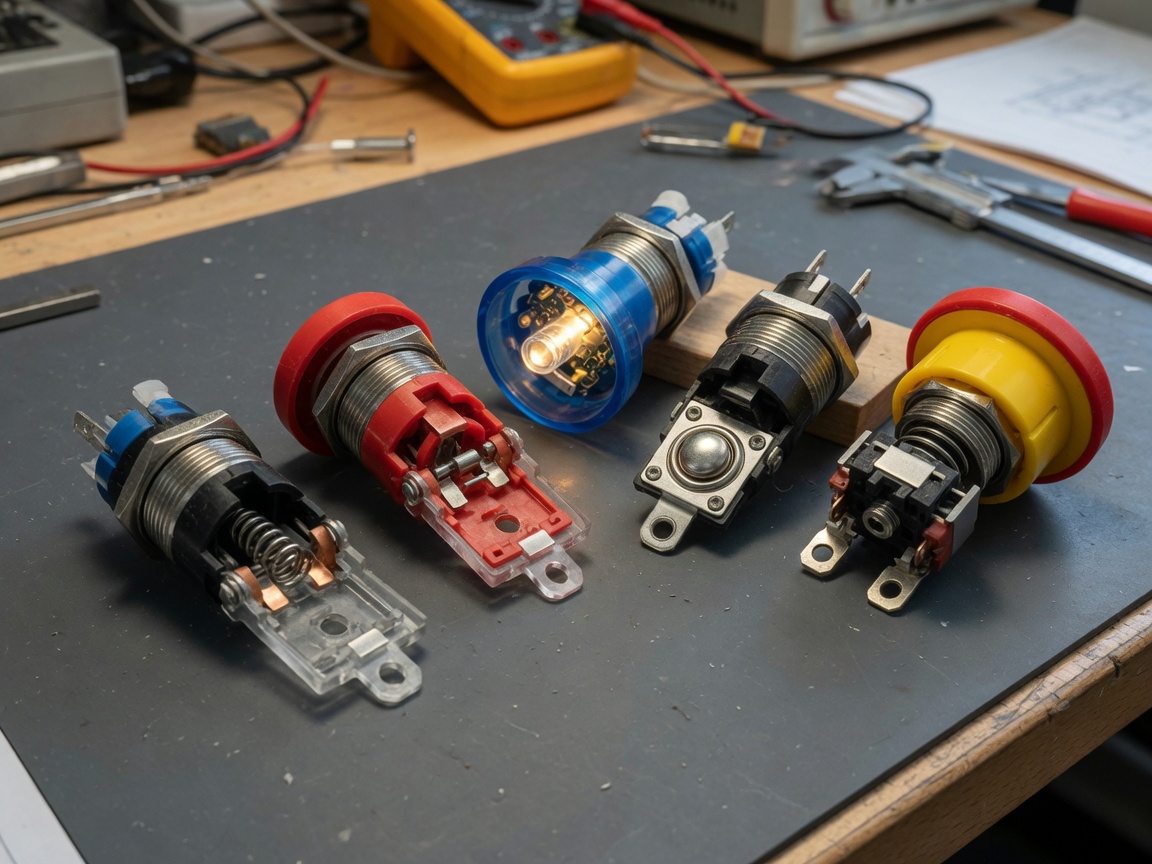
An illuminated push button switch integrates an LED (or, in older designs, an incandescent lamp) directly into the actuator body, providing visual status feedback without a separate indicator. LED-illuminated variants now dominate new installations given their low power draw (typically under 0.5 W), 50,000-hour rated lamp life, and compatibility with 12 V, 24 V, and 230 V AC supply voltages. In machine guarding and process control applications, illuminated switches double as human-machine interface (HMI) indicators — reducing panel complexity. A power symbol annular ring variant is specifically engineered as the main power switch for medium and large industrial equipment, combining visual clarity with ergonomic actuator geometry.
Tactile switches and PCB-mount types
The tactile switch — a miniature, surface-mount or through-hole device generating audible and tactile click feedback — is the dominant type in consumer electronics, instrumentation, and home automation controller boards. Operating forces typically range from 100 gF to 260 gF, with contact ratings of 50 mA at 12 V DC being standard for logic-level signalling. They are not interchangeable with panel-mount industrial types; conflating them in a specification is a costly error.
Emergency stop and safety switches
Emergency stop (E-stop) push buttons are a legally distinct subcategory governed by ISO 13850 and referenced in IEC 60204-1. They use a large mushroom-head actuator (typically 40 mm or 60 mm diameter), require a positive-break contact mechanism, and must be coloured red on a yellow background — a non-negotiable IEC 60204-1 requirement that post-Brexit UK legislation (UKCA marking) retains in full. A latching E-stop that requires deliberate key-release or twist-release prevents accidental re-energisation.
12 V push button switches for automotive and low-voltage DC
A 12 V push button switch optimised for automotive or low-voltage DC applications differs from an industrial AC switch in its contact material and arc-suppression design. DC switching is inherently harder on contacts than AC because the arc does not self-extinguish at a zero crossing — so a switch rated 10 A at 250 V AC may only be rated 3 A at 12 V DC. Always cross-check the push button switch datasheet for separate AC and DC ratings before committing to a design.
UK standards and compliance: what engineers must know in 2026
UK compliance is the single most underserved topic in existing online content about push button switches — and it is precisely the area where specification errors carry the greatest legal and commercial risk. Since Brexit, the UK has operated a parallel standards regime that diverges from EU CE marking in several practical respects.
BS EN 60947-5-1 and what it requires
BS EN 60947-5-1 is the primary UK/British Standard governing low-voltage switchgear and controlgear control circuit devices, including push button switches for industrial applications. It specifies utilisation categories (AC-12, AC-15, DC-12, DC-13), rated impulse withstand voltages, mechanical and electrical endurance requirements, and verification test procedures. When sourcing push button switches for industrial panels in the UK, confirming BS EN 60947-5-1 compliance — not merely IEC 60947-5-1 — is essential for UKCA marking purposes. The two standards are technically identical in 2026, but the UKCA mark requires third-party testing by a UK-approved body (UKAS-accredited), not a EU Notified Body.
IEC 60204-1 colour coding: a non-negotiable safety rule
IEC 60204-1 (Safety of machinery — electrical equipment) mandates specific actuator colours for push button switches based on function. These requirements are legally enforced under the UK Supply of Machinery (Safety) Regulations 2008 (as retained and amended post-Brexit) and are not optional design choices:
| Function | Mandatory colour (IEC 60204-1) | Typical application | Notes |
|---|---|---|---|
| Start / ON | Green | Motor start, conveyor run | White also permitted |
| Stop / OFF | Red | Motor stop, de-energise | Black also permitted |
| Emergency stop | Red on yellow background | Safety circuit, E-stop | Mandatory — no substitution |
| Reset | Blue or White | Fault reset, alarm acknowledge | Reset button switch applications |
| General / Unassigned | White, Grey, or Black | Jog, inch, lamp test | Avoid green/red for non-safety use |
"Correct colour coding of actuators is not a styling decision — it is a functional safety requirement under IEC 60204-1. Incorrect colours have been cited in UK HSE investigations as contributing factors in operator error incidents." — Industry consensus position, IET Wiring Regulations guidance note, 2025 revision.
IP ratings and ATEX: choosing the right protection for UK environments
IP (Ingress Protection) rating selection is an area where generalisation is dangerous. Many buyers assume a single IP rating covers all "outdoor" or "wet" scenarios. In practice, the difference between IP65 and IP67 — or between an IP-rated switch and an ATEX-certified one — can be the difference between a safe, compliant installation and a liability.
IP rating decision framework for UK applications
The IP code (IEC 60529 / BS EN 60529) has two digits: the first indicates solid particle protection, the second liquid ingress protection. For UK industrial environments, consider the following guidance based on real-world installation scenarios:
- IP40 — Indoor, dry, non-dusty environment (office equipment, consumer units in dry domestic settings)
- IP54 — Dust-protected, splash-resistant (light manufacturing, outdoor enclosures under a canopy)
- IP65 — Dust-tight, protected against water jets (food processing wash-down areas, outdoor panels exposed to rain)
- IP67 — Dust-tight, temporary immersion to 1 m for 30 minutes (subsurface drainage pump controls, marine deck applications)
- IP68 — Dust-tight, continuous immersion beyond 1 m (specified per manufacturer — offshore, underwater installations)
Why do so many engineers get this wrong? Because IP65 panels are marketed as "weatherproof" — which they are — but a panel installed near a Kärcher pressure washer or food production CIP (clean-in-place) rinse station experiences high-velocity water at close range. IP65 only certifies protection against water jets from a standard nozzle at 2.5–3 m distance. For high-pressure wash-down, IP66 or IP69K is appropriate. The distinction matters enormously in UK food processing and pharmaceutical environments.
ATEX certification: UK oil, gas, and food processing requirements
ATEX (from the French "ATmosphères EXplosibles") certification is mandatory for electrical components — including push button switches — installed in potentially explosive atmospheres. In UK law, this is governed by the Dangerous Substances and Explosive Atmospheres Regulations 2002 (DSEAR) and, post-Brexit, UKEX marking has been phased in alongside retained ATEX recognition. In practice, for 2026 UK procurement: equipment already certified to ATEX II 2G (Zone 1) or ATEX II 3G (Zone 2) remains fully valid for UK installations. Purchasing teams should verify whether suppliers hold both ATEX and UKEX certificates, particularly for new equipment destined for North Sea oil platforms, UK grain storage facilities, or solvent-handling pharmaceutical sites.
Push button switch wiring: configurations and practical guidance
Correct push button switch wiring is fundamental — yet wiring diagrams for real UK applications are almost entirely absent from competitor content. The following covers the three most common UK scenarios.
Normally open vs normally closed wiring
A normally open push button switch (NO contact) has terminals that are open circuit at rest. Pressing the button bridges the contacts, completing the circuit. Used for START, RUN, and momentary trigger functions. A normally closed push button switch (NC contact) is closed at rest; pressing opens the circuit. Used for STOP, INHIBIT, and safety interlock functions. Most industrial electrical push button units provide both NO and NC terminals on the same contact block — essential for control relay logic.
For a basic motor start-stop circuit in a UK consumer unit or small industrial panel, a common wiring arrangement uses:
- Live supply (L1) connected to the normally closed STOP button (NC terminal).
- Output of the STOP button connected to the normally open START button (NO terminal).
- Output of the START button connected to the motor contactor coil (A1 terminal).
- A holding contact (auxiliary NO contact of the contactor) wired in parallel across the START button to provide latching/seal-in.
- Contactor coil neutral (A2) returned to neutral bar.
This arrangement — sometimes called a "two-wire hold-in circuit" — is the standard taught in City & Guilds Level 3 and IET Wiring Regulations (18th Edition) training for UK electricians. It ensures the motor drops out the moment either supply is interrupted or the STOP button is pressed, with no possibility of unintended re-start.
Home automation and low-voltage wiring
In modern UK home automation installations — using platforms such as KNX, Loxone, or Shelly — push button switches often operate at SELV (Safety Extra-Low Voltage, typically 12 V or 24 V DC). The electrical push button serves purely as an input device; switching of loads is handled by a separate relay or smart module. Here, a 12 V push button switch with a NO momentary contact is wired directly to a digital input terminal on the controller. Toggle switch behaviour (latching on/off) is then implemented in software, not mechanically — offering greater flexibility for reconfiguration without rewiring.
Brand comparison: Omron, Schneider Electric, Siemens, and ABB
No independent side-by-side comparison of leading push button switch brands — specific to UK availability and procurement reality — currently exists in competitor content. The table below reflects 2026 pricing and availability data from major UK distributors including RS Components, Farnell, and Würth Elektronik.
| Brand | Series (22 mm panel) | Price range (GBP, per unit) | Typical MTBF / mechanical life | UK distributor lead time | BS EN 60947-5-1 |
|---|---|---|---|---|---|
| Omron | A22 Series | £6 – £28 | 1,000,000 ops mechanical | In stock / 1–3 days | Yes |
| Schneider Electric | Harmony XB4 / XB5 | £8 – £45 | 1,000,000 ops mechanical | In stock / 1–5 days | Yes |
| Siemens | SIRIUS ACT 3SU1 | £10 – £55 | 10,000,000 ops mechanical | 2–7 days (some ex-stock) | Yes |
| ABB | Ability / CP range | £9 – £50 | 1,000,000 ops mechanical | 3–10 days | Yes |
Siemens SIRIUS ACT stands out for its exceptional rated mechanical life — up to 10 million operations — which justifies the premium price point for high-cycle applications such as packaging lines or continuous process equipment. For moderate-duty installations with tighter budgets, Omron's A22 series offers broad UK distributor availability and a well-documented push button switch datasheet ecosystem. Schneider's modular Harmony range is the preferred choice when mix-and-match actuator/contact block configurations are needed across a large panel build.
Of course, there are situations where branded industrial switches are overkill. For a simple consumer unit isolation application or a home automation retrofit, a generic 16 mm momentary push button at under £2 from a reputable UK supplier will perform perfectly adequately — provided it carries the appropriate UKCA or CE mark.
Sustainability, RoHS, and REACH: what UK buyers need to consider post-Brexit
Sustainability compliance is entirely absent from competitor content on push button switches — yet for UK procurement teams in 2026, it carries real legal and commercial weight.
RoHS compliance and the UK REACH regulations
The UK RoHS Regulations 2012 (as amended) restrict hazardous substances in electrical and electronic equipment sold in Great Britain. Push button switches — classified as EEE Category 9 (monitoring and control instruments) — must comply. In practice, this means lead-free solder on PCB-mounted tactile switches, cadmium-free contact platings on industrial types, and compliance declarations on datasheets. Post-Brexit, UK REACH (Registration, Evaluation, Authorisation and Restriction of Chemicals) operates independently from EU REACH. Importers of push button switches from non-UK manufacturers must maintain their own UK REACH compliance records — a responsibility that previously sat with EU-based manufacturers under the old framework.
Practical implications for UK buyers importing from Asia
A significant proportion of value-tier push button switches sold in the UK are manufactured in China or Taiwan. Since 2021, UK importers bear legal responsibility for verifying RoHS compliance themselves, rather than relying on the CE mark. Requesting a full RoHS Declaration of Conformity (DoC) and material composition report (ideally referencing IEC 62321 test methods) from suppliers is now standard practice for responsible procurement teams. The added administrative burden is real — but it protects against both regulatory liability and the reputational risk of supplying non-compliant equipment to end customers. Just as a chain is only as strong as its weakest link, a product's compliance posture is only as sound as its least-documented component.
How to choose the right push button switch: a step-by-step guide
Bringing all the preceding considerations together into a structured selection process eliminates most specification errors before they happen. The following steps reflect best practice for UK procurement decisions in 2026.
Step-by-step selection process
- Define the switching function: Momentary (NO or NC) or latching? Start/stop, safety, indicator, or general purpose?
- Establish the electrical ratings: Confirm supply voltage (12 V DC, 24 V DC, 230 V AC), maximum switched current, and whether AC or DC — check the datasheet for both. Do not assume AC ratings apply to DC circuits.
- Select the mounting format: Panel mount (16 mm / 19 mm / 22 mm hole) or PCB mount (tactile switch)? Confirm panel thickness and available bezel depth.
- Determine the required IP rating: Use the decision framework above. Outdoor UK installations in exposed positions warrant minimum IP65; wash-down environments require IP66 or IP69K.
- Check ATEX requirements: Is the installation in a potentially explosive atmosphere? If yes, DSEAR-compliant ATEX or UKEX certification is mandatory — not optional.
- Verify colour coding compliance: Apply IEC 60204-1 actuator colour rules. This is a legal requirement under UK machinery regulations, not an aesthetic preference.
- Confirm standards compliance: BS EN 60947-5-1 for industrial applications; UKCA or CE marking as appropriate; RoHS DoC from the manufacturer.
- Assess life cycle and total cost: High-cycle applications (>100,000 operations per year) warrant reviewing mechanical life ratings and MTBF figures. A switch costing twice as much but rated for ten times the mechanical life is frequently the more economical choice over a five-year horizon.
Common mistakes to avoid
Why do so many otherwise competent engineers still get push button switch selection wrong? Typically, it comes down to three persistent habits: specifying on price alone without checking datasheet ratings for the actual operating voltage and current; assuming CE-marked products are automatically UKCA-compliant (they are not, post-Brexit, for new installations after June 2025 in Great Britain); and overlooking the distinction between electrical and mechanical life ratings. Mechanical life (number of operations with no load) is almost always higher than electrical life (operations at rated load) — sometimes by a factor of ten. Specifying mechanical life for a high-current application will shorten the switch's real-world service life dramatically.
Frequently asked questions
Common questions answered
Q: What is the difference between a normally open and normally closed push button switch?
A: A normally open (NO) push button switch has open contacts at rest and closes the circuit when pressed — used for START functions. A normally closed (NC) push button switch has closed contacts at rest and breaks the circuit when pressed — used for STOP and safety interlock functions. Most industrial units provide both contact types on the same body.
Q: Do push button switches need to comply with BS EN 60947-5-1 in the UK?
A: Yes, for industrial control panel applications in Great Britain. BS EN 60947-5-1 governs low-voltage control circuit devices, and UKCA marking requires conformity assessment by a UKAS-accredited body. Consumer and domestic applications may fall under different regulations depending on the product category and installation context.
Q: What IP rating should I choose for an outdoor push button switch in the UK?
A: For standard UK outdoor environments exposed to rain, IP65 is the minimum recommended. For wash-down environments (food processing, vehicle wash bays), specify IP66 or IP69K. IP67 is appropriate for temporary immersion risk. Always verify the rating against the specific cleaning or exposure conditions of your installation.
Q: Can I use a CE-marked push button switch in a UK installation in 2026?
A: For new equipment placed on the Great Britain market after June 2025, UKCA marking is generally required. CE-marked products may still be used in Northern Ireland (which follows UK/EU dual-marking rules). Transitional arrangements ended — confirm UKCA compliance with your supplier before purchasing for new GB installations.
Q: What is the standard panel mounting hole size for industrial push button switches in the UK?
A: The 22 mm mounting hole is the dominant standard for industrial control panels in the UK, widely supported by Omron, Schneider Electric, Siemens, and ABB. 16 mm and 19 mm sizes are used for compact panels or non-standard applications. Confirm the panel thickness tolerance, as this affects bezel engagement and IP rating integrity at the panel face.
Selecting the right push button switches for any UK application in 2026 demands more than picking the first component that matches the operating voltage. Standards compliance (BS EN 60947-5-1, IEC 60204-1 colour coding), UKCA marking obligations, IP and ATEX protection levels, electrical versus mechanical life ratings, and post-Brexit RoHS/REACH responsibilities all intersect in the specification decision. Apply the step-by-step selection process above, cross-reference brand datasheets, and always confirm compliance documentation from your supplier before finalising a purchase order. A well-specified push button switch is not merely a reliable component — it is a legal and safety asset embedded in every panel it controls.
Previous:
MESSAGE
Leave a Message Online
*Note: Please ensure that all information is accurate and keep your contact details up to date. We will get in touch with you as soon as possible.
Contact Information
Contact: Manager Zhang (Business Department)
Phone:+86 0769-86302535-8808
Mobile phone:+86 18025227237
E-mail:hosong@hosong.cn
Address: No. 2, Industrial Road No. 1, Xiajiangcheng, Gaobu Town, Dongguan City, Guangdong Province, China

Scan to add the official account
Learn more about WeCom...
Want to learn more about the company’s products and information?
Guangdong HOSONG Button Manufacturing Co., Ltd.
Phone:+86 18025227237 / +86 0769-86302535
WhatsAPP:+86 18025227237
Email:hosong@hosong.cn
Address: No. 2, Industrial Road No. 1, Xiajiangcheng, Gaobu Town, Dongguan City, Guangdong Province, China
HOSONG International (Hong Kong) Limited
Address: Room 15, 11th Floor, Wah Wai Plaza, No. 1008 Tai Nam Sai Street, Lai Chi Kok, Kowloon, Hong Kong
Phone:0852-30780831
Fax:0852-30775900